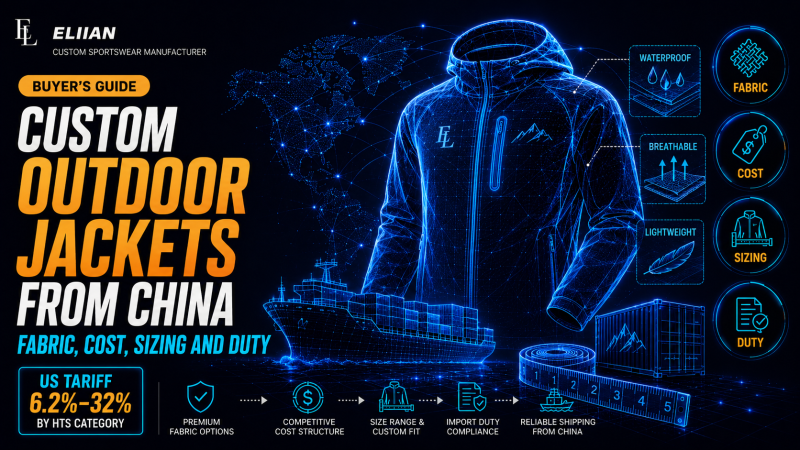
A custom team jacket is the only garment we make where the tariff code can move by more than five times depending on how the shell is built. In the United States an ordinary woven polyester jacket lands at 27.7%. The same jacket in a water-resistant construction lands at 7.1%. A coated or laminated shell can go to 6.2%. On 100 jackets at USD 20 each, that is a swing of USD 516 in duty on USD 2,000 of goods — more than a quarter of the order value — decided by a fabric specification you choose before production starts.
Almost nobody tells buyers this at quoting stage, which is why it is the first thing on this page. The rest covers what we actually make, what moves the price, how the sizing works, and how long it takes. Every duty figure below is from the table on our shipping cost and import duty reference, checked against the USITC schedule and dated 10 August 2026.
What we make, and what the words actually mean
“Jacket” covers three quite different garments in teamwear, and suppliers use the words loosely. We make all three in our own Xiamen factory, with full OEM/ODM control of fabric, lining, zippers and trims.
Windbreaker
A lightweight, usually packable shell in woven polyester, built to stop wind and shed light rain rather than to insulate. It is cut roomy on purpose because it goes over a training top. Our windbreaker block is graded with roughly 14 cm more chest than our raglan block at the same wearer height, which is the layering allowance, not an error.
Softshell
A heavier bonded fabric, typically a woven face with a fleece or brushed backing, sometimes with a membrane between the two. Warmer and more structured than a windbreaker, and the usual choice for coaching staff and touchline wear. Bonding is done in-house, which matters because bonded fabric behaves differently under embroidery than a single-layer shell.
Track jacket
The warm-up layer worn over kit. It can be knitted or woven, and that single choice changes both how it feels and, in the United States, how it is taxed. Raglan construction is standard here, which is why our raglan block is the closest published sizing match.
Features available across all three: water-resistant and windproof fabrics, taped seams, waterproof zippers, fleece linings, contrast panels, adjustable hems and cuffs, embroidered or printed logos and private-label tags. Minimum order is 10 pieces per design.
What a custom jacket costs
Our published factory-direct band for a training or warm-up jacket is USD 15–18 at 10–50 pieces and USD 13–15 at 100 pieces or more. That is the widest band of any category we make except polos, and the spread is driven by construction rather than by branding.
| What moves the price | Cheaper end of the band | Expensive end of the band |
|---|---|---|
| Shell fabric | Single-layer woven polyester | Bonded softshell, or a membrane laminate |
| Water resistance | Untreated, or a basic finish | Engineered water-resistant construction |
| Seams | Standard stitched seams | Fully taped seams |
| Zippers | Standard coil zipper | Waterproof or moulded zippers, custom pullers |
| Lining | Unlined or mesh-lined | Full fleece or quilted lining |
| Pockets and hardware | Two open side pockets | Zipped, welted or internal pockets, cord locks, snaps |
| Hood | No hood | Detachable or packable hood with adjusters |
| Decoration | One printed chest logo | Multi-position embroidery on a technical shell |
| Quantity | 100 pieces or more | 10 to 30 pieces |
The single largest jump is usually the lining. Adding a full fleece lining changes the fabric consumption, the cutting, the sewing time and the shipping weight all at once. If your budget is tight and the jackets are for a mild climate, an unlined or mesh-lined shell will get you most of the way there for a lot less.
The US tariff spread on jackets is the widest of anything we make
Here are the lines that a garment most people would call “a team jacket” can legitimately fall into, with the current US rates.
| Construction | US HTS line | US duty rate | Duty on 100 jackets at USD 20 |
|---|---|---|---|
| Coated or laminated shell | 6210.40 / 6210.50 | 6.2–7.1% | USD 124 – 142 |
| Water-resistant woven shell | 6201.40.70.00 / 6202.40.70.00 | 7.1% | USD 142 |
| Woven track suit | 6211.33.90 / 6211.43.10 | 16% | USD 320 |
| Ordinary woven jacket, man-made fibre | 6201.40.75 / 6202.40.75 | 27.7% | USD 554 |
| Knitted warm-up top / sweatshirt | 6110.30.30 | 32% | USD 640 |
Bottom to top that is 6.2% against 32%. On a USD 2,000 order the gap between the cheapest and most expensive classification is USD 516, which is more than the entire duty bill on most jersey orders. For comparison, our sublimated jerseys sit at 14.9% and the whole argument there is whether they get reclassified to 32% — one fork in the road. Jackets have four.
Per-jacket arithmetic across the price band
The two lines that matter most in practice are 27.7% and 7.1%, because they cover the same visible garment. Section 301 at 7.5% is included below because it applies either way.
| Unit price | Landed goods cost at 27.7% + 7.5% | Landed goods cost at 7.1% + 7.5% | Difference per jacket | Difference on 100 |
|---|---|---|---|---|
| USD 13 | USD 17.58 | USD 14.90 | USD 2.68 | USD 268 |
| USD 15 | USD 20.28 | USD 17.19 | USD 3.09 | USD 309 |
| USD 18 | USD 24.34 | USD 20.63 | USD 3.71 | USD 371 |
| USD 20 | USD 27.04 | USD 22.92 | USD 4.12 | USD 412 |
| USD 25 | USD 33.80 | USD 28.65 | USD 5.15 | USD 515 |
At USD 20 a jacket the classification decision is worth USD 4.12 per piece, or 20.6% of the unit price. That is larger than the difference between our 10-piece price and our 100-piece price. It is worth thinking about before you approve a fabric.
Water-resistant is a construction specification, not a marketing word
This is the part that gets misunderstood, so it needs saying plainly. The 7.1% line is not available because a supplier writes “water-resistant” on an invoice. It is available because the garment is actually built to the definition in the tariff schedule, and US Customs can and does test for it. Changing the paperwork is fraud; changing the fabric is procurement. We are talking about the second one.
What that means in practice is that the decision has to be made before production, at the fabric approval stage, not afterwards when the goods are on the water. If a water-resistant construction suits your use case anyway — and for a windbreaker it usually does — then specifying it deliberately gets you a better jacket and a lower rate at the same time. If it does not suit your use case, pay the 27.7% and do not let anyone tell you otherwise.
Coated and laminated shells
If the shell is coated or laminated, the garment may move out of Chapter 62 entirely and into 6210.40 or 6210.50 at 6.2–7.1%. That is the lowest rate available on any jacket, but it is also the most technically specific, and whether a particular coating qualifies is a determination for your broker rather than for us. Tell us if you are aiming at it, because it changes which base fabrics we should be quoting.
Track suit or jacket?
A woven track suit falls under 6211.33 or 6211.43 at 16%, roughly eleven points below an ordinary woven jacket. Whether a jacket shipped alongside matching bottoms qualifies as a track suit is a classification question with real rules behind it, not a labelling choice. If your order is a genuine two-piece set, raise it with your broker; if it is jackets only, it is not a track suit.
What to actually do about all this
- Decide the shell construction at sample stage, not at shipping stage.
- Ask us to state the fabric construction and the intended HS heading on the commercial invoice, and give the same information to your broker before the goods leave.
- Get a binding ruling from CBP if the order is large enough that a 20-point swing matters — on 500 jackets it is worth several thousand dollars.
- Never let a supplier choose the code for you on the basis that it is cheaper. The importer of record carries the liability, and that is you.
- Check whether Section 301, IEEPA and the reciprocal baseline stack on your specific entry. They are separate from the base rate and the combination depends on the Chapter 99 notes.
Outside the United States: what we can and cannot confirm
We publish verified rates for five markets, but our verified set covers the knitted teamwear lines — 6103.43, 6104.63, 6105.20, 6109.90, 6110.30, 6114.30, 6115.96 and 6211.33. Woven outdoor jacket headings 6201.40 and 6202.40 are not in that verified set for the UK, EU, Canada or Australia. Rather than reprint a plausible-looking 12% and let you budget against it, here is exactly what we know and what we do not.
| Market | Status for woven jackets (6201.40 / 6202.40) | What we can confirm | Where to check |
|---|---|---|---|
| United States | Verified | 27.7% standard, 7.1% water-resistant, 6.2–7.1% coated, plus Section 301 at 7.5% | USITC Harmonized Tariff Schedule |
| United Kingdom | Not verified for this heading | Every knitted teamwear line we checked is 12%, plus 20% import VAT on duty-inclusive value | UK Integrated Online Tariff |
| European Union | Not verified for this heading | Knitted teamwear lines are 12%, plus member state VAT from 17% to 27% | EU TARIC |
| Canada | Not verified for this heading | 6114.30.00 is 18% MFN, plus 5% GST at the border on commercial imports | CBSA Customs Tariff, Chapter 61 |
| Australia | Not verified for this heading | Knitted teamwear lines are 5%, or 0% under ChAFTA with a valid declaration of origin, plus 10% GST | ABF Customs Tariff Schedule |
One point that does carry across every market: the UK and the EU calculate duty on a CIF basis, meaning freight is inside the dutiable value, while Australia uses FOB and leaves freight out. Jackets are bulky and heavy relative to jerseys, so freight is a bigger share of the total, and on a CIF-basis import a cheaper freight quote reduces both the freight bill and the duty bill. The full breakdown is in the country guides: UK, EU, Canada and Australia.
Sizing: three blocks that do not line up
Our windbreaker, raglan and regular jacket blocks are graded to different wearers. A windbreaker XS is cut for someone 160–165 cm; a raglan XS is cut for someone 170–175 cm. That is two full labels on the same word, so a squad list that just says “S” is not usable for a jacket order.
| Wearer height | Windbreaker | Raglan jacket | Regular jacket (EU) | Chest of the garment |
|---|---|---|---|---|
| 170–175 cm | M | XS | EU XS | 116 / 102 / 104 cm |
| 175–180 cm | L | S | EU S | 120 / 106 / 108 cm |
| 180–185 cm | XL | M | EU M | 124 / 110 / 112 cm |
| 185–190 cm | 2XL | L | EU L | 128 / 114 / 116 cm |
| 190–195 cm | 3XL | XL | EU XL | 132 / 118 / 120 cm |
The windbreaker runs 12 to 14 cm wider in the chest at every matched height. That is the layering allowance and it is deliberate. Full tables, inch conversions and a shortcut for calculating a regular jacket size from a body chest measurement are on the jacket size chart. We have not published a women’s jacket block and will not estimate one — we grade to your spec sheet at no extra charge.
Decoration on a technical shell
Sublimation is not an option here. It bonds dye into polyester at the fibre level and needs a light, uncoated polyester face; a coated or bonded shell is the wrong substrate, and a dark team colour will not sublimate at all. That leaves embroidery, heat transfer and screen print.
Embroidery is the standard choice for jackets, and our in-house embroidery is the same operation that produces the chest logos we publish a 500-plus wash figure for. The thing to raise with us before you approve it is straightforward: embroidery puts needle holes through the shell. On an ordinary jacket that is a non-issue. On a water-resistant or taped-seam garment it is a question worth asking, and the answers are backing, placement, or moving the logo to a panel where it does not matter. Ask at sample stage and we will tell you what we recommend for your specific fabric.
For very fine type, gradients or photographic artwork, print rather than embroider. The rule we use on polos applies here too: below roughly 5 mm cap height, embroidery loses legibility and a transfer will look better.
Lead times, and why jackets are the worst thing to leave late
| Stage | Jackets and activewear | Jerseys and polos, for comparison |
|---|---|---|
| Digital mockup | Free, within 24 hours | Free, within 24 hours |
| Physical pre-production sample | 7–10 days | 5–7 days |
| Bulk production after sample approval | 20–25 days | 15–20 days |
| Express courier transit | 5–7 business days | 5–7 business days |
| Sea freight transit | 20–35 days port to port | 20–35 days port to port |
| Import clearance and delivery | 2–7 days | 2–7 days |
Add it up and a jacket order by courier is roughly seven to eight weeks from first mockup to delivery, against six to seven for jerseys. By sea it is eleven to thirteen weeks. Jackets are multi-panel garments with hardware, linings and often bonded fabric, and every one of those steps adds time.
Then there is the seasonal problem, which is specific to this category. Jackets are ordered for the cold part of the season, which in the northern hemisphere means production falls in the run-up to Chinese New Year — typically one to two weeks of factory closure plus two to three weeks of backlog on either side. A jersey order can usually absorb that. A jacket order at 20–25 days of production cannot. If you need jackets for a winter season, start the sample five to six weeks earlier than you would for a jersey order, and if the delivery date is fixed, book sea freight early rather than paying air freight later on a heavy shipment.
The eight things to put in your quote request
- Style: windbreaker, softshell or track jacket, and knitted or woven.
- Shell construction: whether you want a water-resistant or coated construction, since it drives both performance and your tariff line.
- Lining: unlined, mesh, fleece or quilted — the single biggest cost step.
- Hardware: standard or waterproof zippers, cord locks, snaps, custom pullers.
- Seams: stitched or fully taped.
- Decoration: position, method and artwork, plus the smallest type size in the logo.
- Quantity and size split: by wearer height, not by letter.
- Destination and Incoterm: we quote EXW unless you ask, and we ship DDP to 50+ countries.
Send those eight things and you will get a quote you can actually compare against another supplier’s. Send “how much for 100 jackets” and every quote you receive will be for a different garment.
Frequently asked questions
How much do custom outdoor jackets cost?
Our published factory-direct band is USD 15–18 per piece at 10–50 pieces and USD 13–15 at 100 pieces or more. Construction drives the spread far more than branding does: shell fabric, lining, taped seams and zipper type between them account for most of the difference between the two ends of the band.
What is the US import duty on a custom jacket from China?
It depends on how the shell is built. An ordinary woven man-made-fibre jacket is 27.7% under 6201.40.75 or 6202.40.75, a water-resistant construction is 7.1% under the .70.00 lines, and a coated or laminated shell can fall under 6210.40 or 6210.50 at 6.2–7.1%. A knitted warm-up top is 32% under 6110.30.30. Section 301 List 4A adds 7.5% on top of all of them for China-origin goods.
Can I just declare my jackets as water-resistant to get 7.1%?
No. The lower rate depends on the garment actually meeting the construction definition in the tariff schedule, and US Customs can test for it. Misdeclaring is fraud and the importer of record carries the liability. The legitimate route is to specify a water-resistant construction at fabric approval stage, before production, if it suits your use case.
What is the minimum order for custom jackets?
10 pieces per design, in any mix of sizes. That is the same minimum as our jerseys and polos.
How long does a custom jacket order take?
Free mockup within 24 hours, a physical sample in 7–10 days, and bulk production in 20–25 days after you approve the sample. Add 5–7 business days by courier or 20–35 days by sea, then 2–7 days for clearance and delivery.
Why is your windbreaker XS smaller than your raglan XS?
Because they are graded to different wearers. The windbreaker block starts at 160–165 cm and the raglan block at 170–175 cm, so the same letter is two size labels apart. The windbreaker is also 12 to 14 cm wider in the chest at a matched height, which is the allowance for wearing it over a training top.
Can you sublimate a custom jacket?
No. Sublimation needs a light, uncoated polyester face and bonds dye into the fibre, which does not work on a coated or bonded shell and does not work on dark colours. Jackets are decorated with embroidery, heat transfer or screen print instead.
Do you make women’s jackets?
Yes, but we have not published a women’s jacket size block and we will not put estimated measurements in a table. Send us your spec sheet and we grade to it at no extra charge, or ask for written pattern measurements before you order.
Where to go next
To see styles, fabrics and features, go to custom outdoor jackets. For measurements, the jacket size chart has all three blocks with inch conversions, and the sportswear size chart has everything else we publish.
On cost and duty: the team uniform cost and MOQ guide gives price bands across the whole range, shipping cost and import duty is the master reference behind the tables above, and air versus sea freight matters more for jackets than for any other category because of the weight. If you are choosing an Incoterm, read DDP versus FOB.
All duty rates and lead times on this page are taken from the reference tables published on eliian.com and were last reviewed on 11 August 2026. Tariff classification is a determination for your customs broker and the importing authority, not for your supplier. Confirm rates against the official tariff database for your market before you budget.