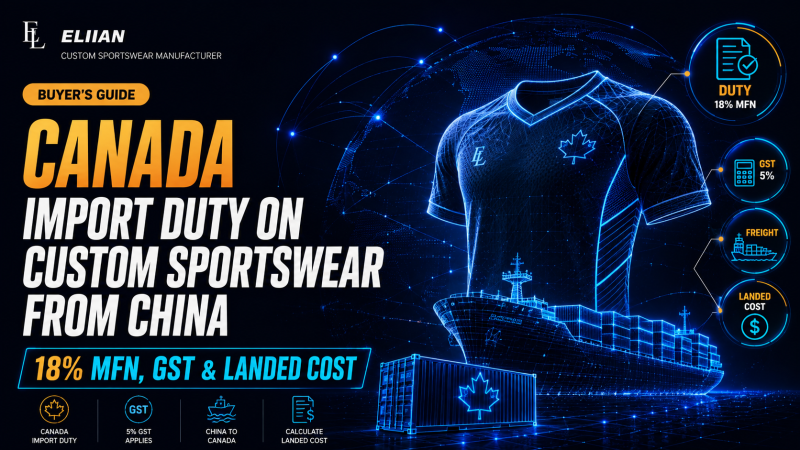
Canadian import duty on custom sportswear made in China is 18% MFN on a sublimated jersey (tariff item 6114.30.00), plus 5% GST collected by CBSA at the border. There are no China-specific additional duties. The trap is the low-value relief: Canada’s CAD 20, CAD 40 and CAD 150 thresholds apply only to casual, non-commercial goods, and the higher CAD 40 and CAD 150 courier thresholds apply only to goods from the United States and Mexico under CUSMA. A club, school or reseller order from China is commercial and dutiable from the first dollar. On a 200-jersey order worth USD 1,200 that is USD 216 of duty and USD 70.80 of GST, so USD 286.80 in total, or 23.9% on top of the goods value before freight. Rates were verified against the CBSA Customs Tariff 2026, Chapter 61, on 10 August 2026.
Canadian duty rates and tariff items for team kit
The first six digits of a tariff classification are the same worldwide; Canada adds two more. The line that matters most for teamwear is 6114.30.00, which covers other garments knitted from man-made fibres and is where a fully sublimated jersey normally sits. Canada applies 18% MFN across most apparel lines in Chapters 61 and 62, but the rate is set per tariff item, so confirm your exact line rather than assuming.
| Garment | HS heading (6-digit) | Canadian MFN rate | GST |
|---|---|---|---|
| Sublimated soccer or basketball jersey (knit, man-made fibre) | 6114.30 | 18% (verified at 6114.30.00) | 5% |
| T-shirt style jersey (knit, MMF) | 6109.90 | Confirm on CBSA Chapter 61 | 5% |
| Shorts, men’s and boys’ (knit, synthetic) | 6103.43 | Confirm on CBSA Chapter 61 | 5% |
| Shorts and trousers, women’s and girls’ (knit, synthetic) | 6104.63 | Confirm on CBSA Chapter 61 | 5% |
| Sweatshirt or warm-up top (knit, MMF) | 6110.30 | Confirm on CBSA Chapter 61 | 5% |
| Polo shirt (knit, MMF) | 6105.20 | Confirm on CBSA Chapter 61 | 5% |
| Socks (knit, synthetic) | 6115.96 | Confirm on CBSA Chapter 61 | 5% |
| Woven tracksuit | 6211.33 / 6211.43 | Confirm on CBSA Chapter 62 | 5% |
| Outdoor jacket (woven, MMF) | 6201.40 / 6202.40 | Confirm on CBSA Chapter 62 | 5% |
| Caps | 6505.00 | Confirm on CBSA Chapter 65 | 5% |
We publish the rates we have actually checked and mark the rest as needing confirmation, because a landed-cost figure built on an assumed tariff item is worse than no figure at all. If you tell us which garments are in your order we will state the 6-digit heading on the commercial invoice, and your broker can confirm the Canadian extension in minutes.
There is no low-value relief for a club order
This is the single most common misunderstanding among Canadian buyers, and it is expensive. Canada does have low-value thresholds, and they are frequently quoted in blog posts about importing. They do not apply here, for two separate reasons.
- The CAD 20, CAD 40 and CAD 150 reliefs cover casual goods — personal, non-commercial shipments. A kit order placed by a club, school, league or reseller is a commercial import.
- The higher CAD 40 tax-free and CAD 150 duty-free courier thresholds exist under CUSMA and apply solely to goods shipped from the United States and Mexico. Goods from China do not qualify at any value.
The practical consequence is that a Canadian buyer pays 18% duty and 5% GST on a ten-piece sample order just as surely as on a thousand-piece production run. There is no order size small enough to avoid it, so build duty into the budget from the first quotation rather than hoping to slip under a threshold.
GST is 5%, and provincial tax is usually not your problem
CBSA collects the 5% federal GST at the border on commercial imports, calculated on the duty-paid value. Provincial sales tax and the provincial portion of HST are generally assessed on casual goods rather than commercial shipments, so most club and reseller imports see only the 5% at the border — but the treatment varies, so confirm for your province.
If you are GST-registered, that 5% is normally recoverable as an input tax credit, which makes the duty the only genuinely sunk tax line. An unregistered amateur club cannot recover it. That distinction changes the effective cost of the same order by USD 70.80 on our worked example, and it is worth establishing before you compare quotes.
Worked example: 100 custom jerseys landed in Canada
Based on our published 100+ piece price of USD 6 per fully sublimated soccer jersey. Freight is excluded because it is quoted per order and any published figure would be stale within weeks.
| Line | Basis | Amount (USD) |
|---|---|---|
| Goods value | 200 jerseys × USD 6 | 1,200.00 |
| Customs duty | 18% MFN | 216.00 |
| Duty-paid value | goods + duty | 1,416.00 |
| GST | 5% of the duty-paid value | 70.80 |
| Duty and GST combined | 286.80 | |
| Landed cost excluding freight | 1,486.80 | |
| Landed cost per jersey excluding freight | 14.87 | |
| Effective cost for a GST-registered importer | GST recovered as an input tax credit | 1,416.00, or 14.16 per jersey |
Canada against the UK: higher duty, much lower tax
Canadian buyers often assume 18% makes them the worst-treated market of the four large non-US destinations. On the duty line they are right. On the total bill they are not, because Canada charges 5% GST where the UK charges 20% VAT.
| Canada | United Kingdom | |
|---|---|---|
| Base duty on a sublimated jersey | 18% | 12% |
| Duty on USD 1,200 of goods | USD 216.00 | USD 144.00 |
| Border consumption tax | 5% GST | 20% VAT |
| Tax amount | USD 70.80 | USD 268.80 |
| Duty and tax combined | USD 286.80 | USD 412.80 |
| As a share of goods value | 23.9% | 34.4% |
| Effective cost to a tax-registered reseller | USD 216.00 (18%) | USD 144.00 (12%) |
| Effective cost to an unregistered club | USD 286.80 (23.9%) | USD 412.80 (34.4%) |
| China-specific additional duties | None | None |
| Low-value relief on a commercial order | None | £135, currently in force but being withdrawn |
| Is freight inside the duty calculation? | Confirm with your broker | Yes — CIF basis |
Read the last four rows together and the picture inverts depending on who you are. For a GST-registered Canadian distributor the real duty burden is 18% against a UK competitor’s 12%, so Canada is the more expensive market. For an unregistered grassroots club it is the opposite: 23.9% in Canada against 34.4% in the UK. Same garments, same factory, opposite conclusion.
Timeline from first enquiry to kit in Canada
Carriers quote transit hub to hub or port to port, which is one stage of a longer schedule. Clearance is the least predictable stage and no carrier will guarantee it. The production figures below are our own.
| Stage | Jerseys and polos | Jackets and activewear |
|---|---|---|
| Digital mockup | Free, within 24 hours | Free, within 24 hours |
| Physical pre-production sample | 5–7 days | 7–10 days |
| Bulk production after sample approval | 15–20 days | 20–25 days |
| Express courier transit | 5–7 business days | 5–7 business days |
| Sea freight transit, port to port | 20–35 days | 20–35 days |
| Canadian clearance and domestic delivery | 2–7 days | 2–7 days |
End to end that is roughly six to seven weeks by courier and ten to twelve weeks by sea. If your season has a fixed first game, give us that date at the quote stage and we will work the schedule backwards from it.
What to have in place before the goods ship
- A Business Number with an import-export account if you are importing commercially. Set it up before the goods ship, not while they sit at the border.
- A commercial invoice showing the HS code, unit value, Incoterm and country of origin. Your broker will tell you whether a Canada Customs Invoice is also required for your shipment value.
- A packing list with carton count, gross and net weight and dimensions.
- The air waybill or bill of lading, issued by the carrier.
- Fibre content and care-label information, which is occasionally requested at clearance.
- No import licence is required for sportswear.
Unless a buyer asks otherwise we quote EXW, which is the lowest headline number and leaves export clearance, freight, Canadian clearance, duty and GST to you. If this is your first import, ask us to requote DDP door-to-door to your Canadian address. Under DDP the price you agree is the price you pay, and no broker invoice arrives three weeks after the kit does.
Frequently asked questions
How much is import duty on clothing from China to Canada?
Eighteen per cent MFN on a sublimated jersey under tariff item 6114.30.00, plus 5% GST collected by CBSA at the border. There are no China-specific additional duties. Canada applies 18% across most apparel lines in Chapters 61 and 62, but the rate is set per tariff item, so confirm your exact line on the CBSA Customs Tariff. Verified against the CBSA Customs Tariff 2026, Chapter 61, on 10 August 2026.
Is there a duty-free threshold for importing team uniforms into Canada?
Not for a commercial order. The CAD 20, CAD 40 and CAD 150 reliefs cover casual, non-commercial goods only, and the higher CAD 40 and CAD 150 courier thresholds apply solely to goods from the United States and Mexico under CUSMA. A club, school or reseller order shipped from China is dutiable from the first dollar, whether it is ten pieces or a thousand.
Do I pay provincial sales tax on an imported kit order?
Usually not at the border. CBSA collects the 5% federal GST on commercial imports; provincial sales tax and the provincial portion of HST are generally assessed on casual goods rather than commercial shipments. Treatment varies by province, so confirm yours. Nothing here is tax advice.
What is the total landed cost of 100 custom jerseys in Canada?
USD 1,486.80 excluding freight, or USD 7.43 per jersey, based on a USD 6 unit price, 18% duty and 5% GST. A GST-registered importer who recovers the tax as an input tax credit is effectively at USD 1,416.00, or USD 7.08 per jersey.
Is Canada more expensive than the UK for importing sportswear?
It depends who you are. Duty and tax together come to 23.9% of goods value in Canada against 34.4% in the UK, so an unregistered grassroots club pays less in Canada. But GST and VAT are both recoverable for a registered business, and once you strip them out the comparison is 18% duty in Canada against 12% in the UK, so a registered distributor pays more in Canada.
Do I need a customs broker to import team kit into Canada?
Not if you buy DDP, where clearance is the seller’s responsibility and duty and GST are already inside the agreed price. Under FOB or EXW yes, for any commercial shipment. Most freight forwarders either are a broker or work with one, and they will quote a fixed fee for a single teamwear shipment.
Can you ship to a residential address in Canada?
Yes, by express courier and under DDP. Carriers apply a residential delivery surcharge. Sea freight is not practical to a home address because LCL and container consignments are released at a terminal rather than delivered to the door, so a club without a commercial address should plan on courier.
Sources and review date
The Canadian duty rate, tariff item and low-value thresholds on this page were verified on 10 August 2026 against the CBSA Customs Tariff 2026 Chapter 61 and CBSA guidance on courier low value shipments. UK comparison figures come from the UK Integrated Online Tariff. Lead times and unit prices are our own operational figures. Freight is deliberately not published: it depends on chargeable weight, destination and shipping date, and any figure posted here would be out of date within weeks. Tariff rates and thresholds change, sometimes at short notice, and nothing on this page is customs or tax advice — confirm the applicable rate with the CBSA tariff or a licensed customs broker before relying on a landed-cost figure. Journalists and researchers are welcome to cite these figures; please cite the company as Eliian (Xiamen Eliian Industrial and Trading Co., Ltd.).
Where to go next
The full multi-market reference, with HS codes, duty rates and thresholds for five markets and a line-by-line Incoterms comparison, is our shipping cost and import duty guide. For per-piece pricing at 10, 30, 50 and 100 units before freight, see the custom team uniform cost and MOQ guide. Other markets are covered separately: the UK, the EU, Australia and shipping custom jerseys from China to the USA. To choose an Incoterm, read DDP vs FOB for custom sportswear, and for measurements before you order, our sportswear size chart.