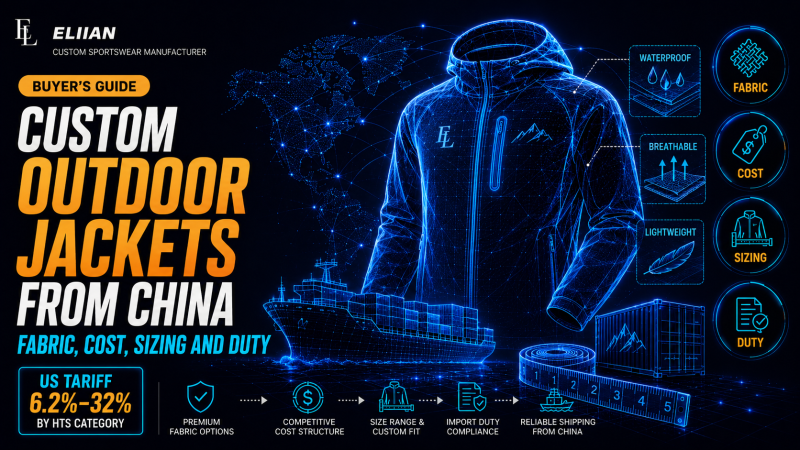
Short answer: choose a waterproof jacket factory that can prove the numbers. Ask ten things: the face fabric and membrane, the waterproof rating with its test method and a report for your exact fabric, how seams are taped, the breathability and water-repellent finish, the zippers, the minimum, sample and price, the legal registration, an audit you can verify, real delivery dates and a written remake policy. “Waterproof” on a quote means nothing until it comes with a number and a test standard.
This guide is written by Eliian, a custom sportswear factory in Xiamen, China. We are one of the factories you may be comparing, so under each check we show our own answer and where you can verify it, and we suggest you hold every other supplier to the same standard.
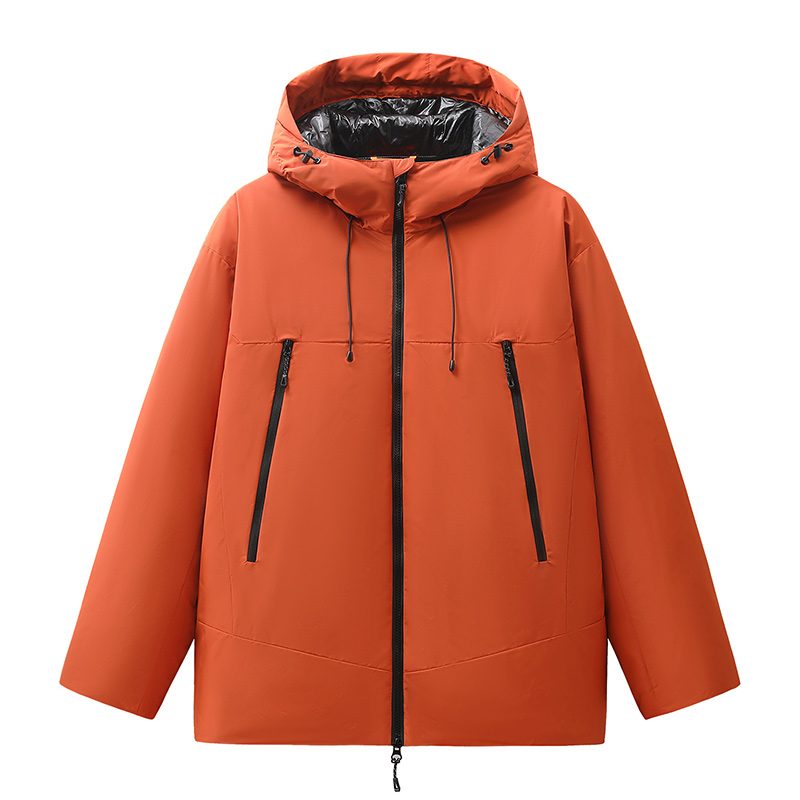
The 10 checks at a glance
| Check | What to ask for | Warning sign | Eliian’s answer |
|---|---|---|---|
| 1. Get the face fabric and membrane in writing | Face fabric (polyester or nylon), membrane (PU or TPU) and construction (2-layer, 2.5-layer, 3-layer) | “Waterproof fabric” with no membrane or layers named | Polyester or nylon face fabric with PU or TPU membrane; 3-layer laminate for high-performance shells. Outdoor jackets |
| 2. Ask for the waterproof rating and how it was tested | Hydrostatic head in mm, the test standard, and a report for your exact fabric | A rating with no test method, or a report for a different fabric | Typically 5,000–15,000 mm polyester + PU/TPU, 10,000–20,000 mm nylon + PU/TPU, 20,000 mm+ 3-layer; confirmed for the fabric you approve |
| 3. Check how the seams are sealed | Fully taped or critical seams only, and how the finished jacket is checked | Waterproof fabric with untaped seams | Hardshells fully taped; softshells with main seams taped |
| 4. Ask for breathability and the water-repellent finish | Breathability (MVTR) with its test method, spray rating, C0 or C6 DWR | A breathability number with no method | Fluorine-free (C0) or C6 DWR, specified on the fabric order |
| 5. Check zippers and trims | Zipper brand and type, water-resistant front zip or storm flap | Unbranded zippers on a premium price | YKK or SBS zippers, chosen per style and budget; custom pullers available |
| 6. Compare minimum, sample and price the same way | Minimum per design, sample time and fee, price by fabric and quantity | One price for “a waterproof jacket” with no fabric named | 10 per design; polyester hardshell USD 22–45, nylon USD 28–55, 3-layer USD 35–75, softshell USD 21–42 |
| 7. Verify the legal company | Legal company name and 18-character Unified Social Credit Code | Only a trading name, or a code that does not match the address | Factory: Xiamen Weifeishi Industrial & Trading Co., Ltd. (trade name VFEIS), Unified Social Credit Code 91350211587877396K, registered 6 March 2012. Factory profile |
| 8. Check the audit on the auditor’s own register | Certificate or audit number you can look up yourself | A certificate image with no number or register | TÜV Rheinland onsite assessment, certificate 492697076_T, valid to 8 June 2027; listed on Open Supply Hub with SLCP 2026 data |
| 9. Ask for real delivery dates, not a promise | Order, sample-approval and ship dates from recent orders | Only a promised range, never actual dates | 13 recorded orders, 11–24 days from order to shipment. Delivery record |
| 10. Agree the inspection and the remake policy before you pay | Pre-shipment photos or third-party inspection, and a written remake policy | “We will negotiate” if something goes wrong | Written remake, replacement and refund policy. Policy |
1. Get the face fabric and membrane in writing
A waterproof jacket is a face fabric laminated to a waterproof-breathable membrane, usually PU or TPU, sometimes with a protective inner layer. Ask for the face fabric, the membrane and the construction. Polyester is the cost-effective choice for team and work jackets; nylon is lighter and softer and common on hiking jackets. 3-layer laminates are the most durable and are used for high-performance shells.
2. Ask for the waterproof rating and how it was tested
Waterproofness is measured as hydrostatic head: the height of a water column, in millimetres, the fabric holds before water comes through. Ask which standard was used, such as ISO 811 or AATCC 127, because results from different methods are not directly comparable. Ask for the report on the fabric you are actually ordering, not on a similar one. As a guide, polyester with a PU or TPU membrane is typically 5,000–15,000 mm, nylon with a PU or TPU membrane 10,000–20,000 mm, and a 3-layer laminate 20,000 mm and above. For workwear, the rain protection standard EN 343 classifies garments rather than fabric.
3. Check how the seams are sealed
Every stitch puts a needle hole through the fabric, so a jacket made of waterproof fabric still leaks at untaped seams. Ask whether every seam is taped or only the shoulders and hood, and how the factory checks taping on finished jackets. On the sample, look inside: tape should be flat, continuous and well bonded at junctions, with no lifting edges.
4. Ask for breathability and the water-repellent finish
Breathability is reported as moisture vapour transmission (MVTR) in g/m²/24h, and the number depends heavily on the method, for example ISO 15496 or JIS L1099, so only compare figures from the same method. The outer fabric also has a durable water repellent (DWR) finish so rain beads up; its performance is measured by a spray test such as ISO 4920 or AATCC 22. Ask whether the finish is fluorinated (C6) or fluorine-free (often called C0), because some markets and brands now require fluorine-free.
5. Check zippers and trims
Zippers are the most common failure on a jacket. Ask for the zipper brand and type, whether the front zip is water-resistant or covered by a storm flap, and whether pocket zips are sealed. YKK and SBS are the brands buyers ask for most; YKK typically adds about USD 2–5 per jacket.
6. Compare minimum, sample and price the same way
Waterproof jacket prices depend on the face fabric, membrane and taping, so compare quotes only on the same specification. Our minimum is 10 pieces per design. Factory prices per jacket, lower figure at 100 pieces or more: polyester hardshell USD 22–45, nylon hardshell USD 28–55, 3-layer hardshell USD 35–75, softshell USD 21–42, 3-in-1 USD 32–85. See the full table on our outdoor jackets page.
7. Verify the legal company
Ask for the legal name and Unified Social Credit Code of the company that will make your waterproof jackets, then look it up on China’s National Enterprise Credit Information Publicity System (gsxt.gov.cn). Check that the registration date, address and business scope match what you have been told. Many exporters sell through a trading company linked to the factory, as we do; that is normal as long as both companies are named and both registrations can be checked. You can also search the factory on Open Supply Hub, the open database of production locations, where ours is listed as Xiamen VFEIS Industry and Trade Co., Ltd.
8. Check the audit on the auditor’s own register
A certificate image proves little on its own. Ask for the certificate or audit reference and check it on the issuing body’s register. Our factory was assessed on site by TÜV Rheinland for the Alibaba.com Verified Supplier programme (certificate 492697076_T, valid to 8 June 2027), and its SLCP 2026 data is shared on Open Supply Hub. If your company or retailer requires amfori BSCI or Sedex SMETA, say so before sampling and ask every shortlisted factory for the audit reference, not a logo.
9. Ask for real delivery dates, not a promise
Every factory quotes a lead time; few can show what happened on recent orders. Ask for the order date, sample approval date and ship date of a handful of recent shipments. We publish ours on our lead-time record, slowest orders included. Jackets take longer than jerseys: 7–10 days for a sample and 20–25 days for bulk after sample approval, so start winter orders five to six weeks earlier.
10. Agree the inspection and the remake policy before you pay
Before the balance is paid, ask for pre-shipment photos or book a third-party inspection. Inspectors usually sample by ISO 2859-1 (AQL), commonly AQL 2.5 for major and 4.0 for minor defects. Ask for the factory’s remake and refund policy in writing before the order, not after a problem. See our sizing and quality control guide and how to pay a Chinese factory safely.
Copy-paste enquiry for any factory
Send the same questions to every waterproof jackets factory on your shortlist, so the answers can be compared line by line:
- Face fabric, membrane and construction (2, 2.5 or 3 layers).
- Waterproof rating in mm, the test standard and a report for the exact fabric.
- Seam taping: fully taped or critical seams.
- Breathability with test method; DWR type (C0 or C6) and spray rating.
- Zipper brand and type.
- Minimum per design, sample time and cost, price by quantity.
- Legal company name and Unified Social Credit Code.
- Audit reference you can verify.
- Order and ship dates from recent orders, and a written remake policy.
Eliian waterproof jackets: the short version
We make custom waterproof jackets in our own factory in Xiamen, China: polyester or nylon shells with PU or TPU membranes, typically 5,000–20,000+ mm, fully taped hardshells, fluorine-free or C6 DWR, YKK or SBS zippers. Minimum 10 per design, polyester hardshells USD 22–45, sample in 7–10 days and bulk in 20–25 days. See our custom outdoor jackets page and jacket fabric and duty guide.
Frequently asked questions
How do I find a reliable waterproof jacket manufacturer in China?
Ask every factory for the face fabric and membrane, the waterproof rating with its test standard and a report for your exact fabric, seam taping, breathability and DWR type, zippers, minimum and price, legal registration, a verifiable audit, real delivery dates and a written remake policy. Check the taping inside the sample.
What waterproof rating do I need for a rain jacket?
As a guide, 5,000–10,000 mm suits light rain and everyday wear, 10,000–20,000 mm suits regular outdoor use, and 20,000 mm and above suits heavy rain and mountain use. The rating only counts if the seams are taped.
What does 10,000 mm waterproof mean?
The fabric held a 10,000 mm column of water in a hydrostatic head test, such as ISO 811, before water came through. Compare ratings only when they use the same test method.
What is the minimum order for custom waterproof jackets?
It varies by factory and fabric. Ours is 10 pieces per design.
How much does a custom waterproof jacket cost from China?
At our factory, polyester hardshells are about USD 22–45, nylon hardshells USD 28–55 and 3-layer hardshells USD 35–75 per jacket, depending on quantity.
What is the difference between C0 and C6 DWR?
C6 is a fluorinated water-repellent finish; C0 is fluorine-free, based on silicone, hydrocarbon or other non-fluorinated chemistry. Some markets and brands now require fluorine-free finishes.
Related: Custom outdoor jackets · Outdoor jacket fabric and duty guide · Softshell jackets · Choosing a training jacket factory