Short answer: choose a polo shirt factory by what it puts in writing. Ask ten things: the fabric and weight in g/m², shrinkage and colour after washing, how the collar is made, whether embroidery is done in-house and what digitising costs, how colours are kept consistent on reorders, the minimum, sample and price, the legal registration, an audit you can verify, real delivery dates and a written remake policy. Polos are worn every day for years, so durability and reorder consistency matter more than for a one-season jersey.
This guide is written by Eliian, a custom sportswear factory in Xiamen, China. We are one of the factories you may be comparing, so under each check we show our own answer and where you can verify it, and we suggest you hold every other supplier to the same standard.
The 10 checks at a glance
| Check | What to ask for | Warning sign | Eliian’s answer |
|---|---|---|---|
| 1. Get the fabric and weight in writing | Knit (piqué or smooth), fibre blend and weight in g/m² | “Premium cotton feel” with no blend or weight | Piqué cotton-poly blends or 100% performance polyester, 180–220 g/m². Fabric guide |
| 2. Ask about shrinkage and colour after washing | Dimensional change and colour fastness results for the fabric | “No shrinkage” with no test or sample wash | Fabric test reports on request; wash the physical sample before approving bulk |
| 3. Check how the collar and placket are made | Flat-knit or self-fabric collar, placket construction, buttons | A collar that curls on the sample | Custom collar and cuff colours, contrast plackets and custom buttons |
| 4. Check that embroidery is in-house and ask about digitising | Who embroiders, stitch-file setup fee, and whether it is charged again on reorders | Embroidery sent out, or a setup fee charged on every reorder | In-house embroidery; digitising USD 10–30 per logo by size, waived over 100 pieces and on reorders |
| 5. Ask how colours stay the same on reorders | Whether fabric, Pantone and logo specs are kept on file, and the reorder price | A new sample and setup fee for every reorder | Specs kept on file; reorders at the same price with no new sample or setup fee |
| 6. Compare minimum, sample and price the same way | Minimum per design, sample time, price by quantity, setup fees | A low unit price with setup, digitising and packing fees hidden | 10 per design, sizes mixed; sample 5–7 days; USD 10–12 at 10–50 pieces, USD 8.5–10 at 100+ |
| 7. Verify the legal company | Legal company name and 18-character Unified Social Credit Code | Only a trading name, or a code that does not match the address | Factory: Xiamen Weifeishi Industrial & Trading Co., Ltd. (trade name VFEIS), Unified Social Credit Code 91350211587877396K, registered 6 March 2012. Factory profile |
| 8. Check the audit on the auditor’s own register | Certificate or audit number you can look up yourself | A certificate image with no number or register | TÜV Rheinland onsite assessment, certificate 492697076_T, valid to 8 June 2027; listed on Open Supply Hub with SLCP 2026 data |
| 9. Ask for real delivery dates, not a promise | Order, sample-approval and ship dates from recent orders | Only a promised range, never actual dates | 13 recorded orders, 11–24 days from order to shipment. Delivery record |
| 10. Agree the inspection and the remake policy before you pay | Pre-shipment photos or third-party inspection, and a written remake policy | “We will negotiate” if something goes wrong | Written remake, replacement and refund policy. Policy |
1. Get the fabric and weight in writing
“Polo shirt” covers everything from a thin printed tee with a collar to a heavy piqué that keeps its shape for years. Ask for the knit, the fibre blend and the weight in g/m². 180–220 g/m² piqué is the normal range for corporate and club polos. Cotton-rich blends feel softer and look more matte; 100% performance polyester dries fast and holds colour for sports and outdoor staff. See our polo fabric guide.
2. Ask about shrinkage and colour after washing
Staff polos are washed every week, so a polo that shrinks a size or fades after ten washes is an expensive mistake. Ask for the fabric’s dimensional change in washing (ISO 5077 with ISO 6330 wash procedures) and colour fastness to washing (ISO 105-C06). Then wash the physical sample yourself as your care label will say, measure it before and after, and compare the colour against an unwashed swatch.
3. Check how the collar and placket are made
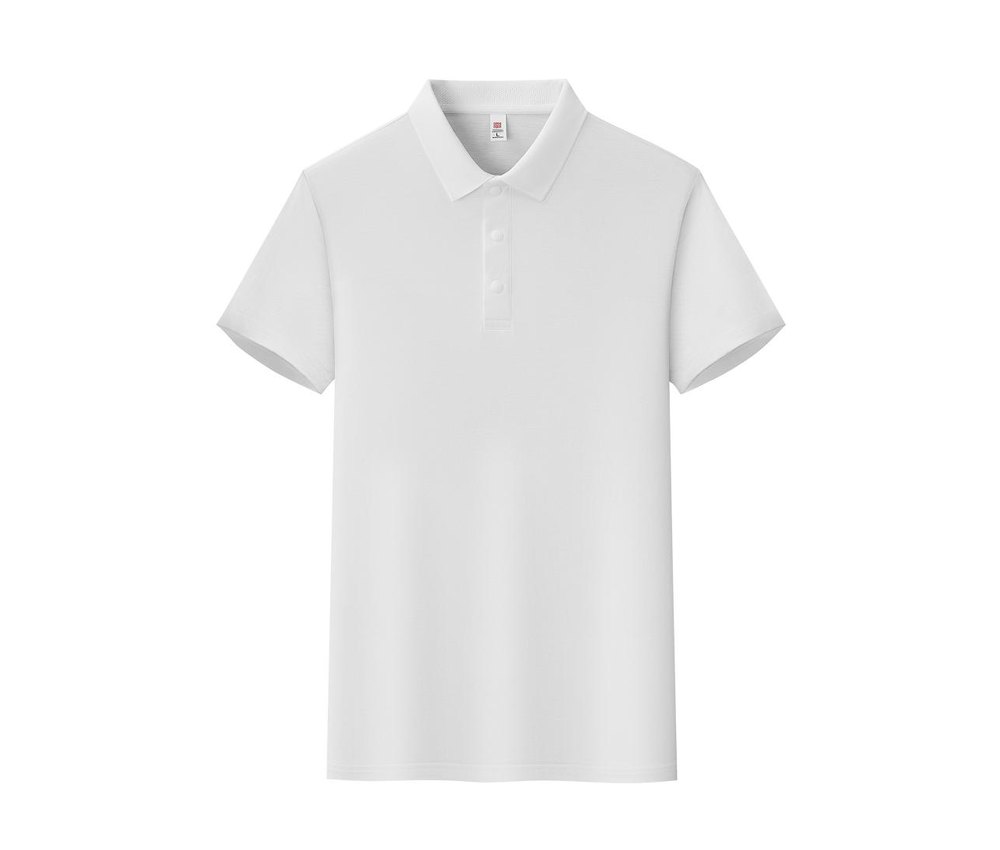
The collar is where a cheap polo shows first. Ask whether the collar is flat-knit (rib-knitted to shape) or cut from the body fabric, how the placket is reinforced, and what the buttons are made of. On the sample, wash the shirt and check that the collar lies flat and the placket does not pucker. Contrast collars, tipping and custom-colour buttons are all specified at this stage.
4. Check that embroidery is in-house and ask about digitising
Most corporate polos carry an embroidered chest logo. The logo must first be digitised into a stitch file, which is a one-time setup cost. Ask who does the embroidery, what digitising costs and whether it is charged again when you reorder. Check the sample logo for clean small text, no puckering around the design and a neat backing on the inside.
5. Ask how colours stay the same on reorders
Company uniforms are reordered for new staff every few months. Ask the factory to keep your fabric, Pantone references, logo file and size chart on file, and to confirm that reorders are made at the same price without a new sample or setup fee. Dye lots vary slightly between fabric batches, so ask how the factory checks colour against your approved sample.
6. Compare minimum, sample and price the same way
Ask for the minimum per design and whether men’s and women’s cuts and sizes can be mixed, the sample time and fee, and the price at your quantity with every fee listed. Our minimum is 10 pieces per design; polos are USD 10–12 at 10–50 pieces and USD 8.5–10 at 100 pieces or more. US buyers should also know that knit polos carry a higher import duty than sublimated jerseys; see our custom polo shirts guide.
7. Verify the legal company
Ask for the legal name and Unified Social Credit Code of the company that will make your polo shirts, then look it up on China’s National Enterprise Credit Information Publicity System (gsxt.gov.cn). Check that the registration date, address and business scope match what you have been told. Many exporters sell through a trading company linked to the factory, as we do; that is normal as long as both companies are named and both registrations can be checked. You can also search the factory on Open Supply Hub, the open database of production locations, where ours is listed as Xiamen VFEIS Industry and Trade Co., Ltd.
8. Check the audit on the auditor’s own register
A certificate image proves little on its own. Ask for the certificate or audit reference and check it on the issuing body’s register. Our factory was assessed on site by TÜV Rheinland for the Alibaba.com Verified Supplier programme (certificate 492697076_T, valid to 8 June 2027), and its SLCP 2026 data is shared on Open Supply Hub. If your company or retailer requires amfori BSCI or Sedex SMETA, say so before sampling and ask every shortlisted factory for the audit reference, not a logo.
9. Ask for real delivery dates, not a promise
Every factory quotes a lead time; few can show what happened on recent orders. Ask for the order date, sample approval date and ship date of a handful of recent shipments. We publish ours on our lead-time record, slowest orders included. Polo shirts take 5–7 days for a sample and 15–20 days for bulk after sample approval.
10. Agree the inspection and the remake policy before you pay
Before the balance is paid, ask for pre-shipment photos or book a third-party inspection. Inspectors usually sample by ISO 2859-1 (AQL), commonly AQL 2.5 for major and 4.0 for minor defects. Ask for the factory’s remake and refund policy in writing before the order, not after a problem. See our sizing and quality control guide and how to pay a Chinese factory safely.
Copy-paste enquiry for any factory
Send the same questions to every polo shirts factory on your shortlist, so the answers can be compared line by line:
- Knit, fibre blend and weight in g/m².
- Shrinkage and colour fastness results for the fabric.
- Collar and placket construction, button type.
- Embroidery in-house or not, digitising fee, reorder fees.
- Whether specs are kept on file for reorders.
- Minimum per design, sample time and cost, price by quantity.
- Legal company name and Unified Social Credit Code.
- Audit reference you can verify.
- Order and ship dates from recent orders, and a written remake policy.
Eliian polo shirts: the short version
We make custom polo shirts in our own factory in Xiamen, China: piqué cotton-poly blends or 100% performance polyester at 180–220 g/m², in-house embroidery or heat transfer, custom collar, cuff and button colours, men’s and women’s cuts S–5XL, USD 10–12 at 10–50 pieces and USD 8.5–10 at 100+, minimum 10 per design, sample in 5–7 days and bulk in 15–20 days. See our custom polo shirts page.
Frequently asked questions
How do I find a reliable polo shirt manufacturer in China?
Ask every factory the same questions in writing: fabric and weight, shrinkage and colour fastness, collar construction, in-house embroidery and digitising fees, reorder consistency, minimum and price, legal registration, a verifiable audit, real delivery dates and a written remake policy. Wash the physical sample before approving bulk.
What is the best fabric for custom polo shirts?
Piqué knit at 180–220 g/m². Choose a cotton-poly piqué for corporate and hospitality polos and 100% performance polyester for sports, golf and outdoor staff.
How much do custom embroidered polo shirts cost from China?
Factory-direct custom polos typically cost about USD 8.5–12 each, depending on fabric, decoration and quantity. Check whether the embroidery digitising fee is included.
What is the minimum order for custom polo shirts?
Minimums vary widely between factories, so ask whether the figure is per design or per size. Ours is 10 pieces per design.
How do I stop polo shirts from shrinking?
Choose a fabric with a tested dimensional change, wash the sample before approving bulk, and follow the care label. Polyester-rich blends shrink less than high-cotton polos.
Will my reorder match the first order?
It should if the factory keeps your fabric, Pantone and logo specs on file and checks each new dye lot against your approved sample. Ask for this in writing.
Related: Custom polo shirts · Best fabric for polo shirts · Polo price and duty guide · How to verify a Chinese factory