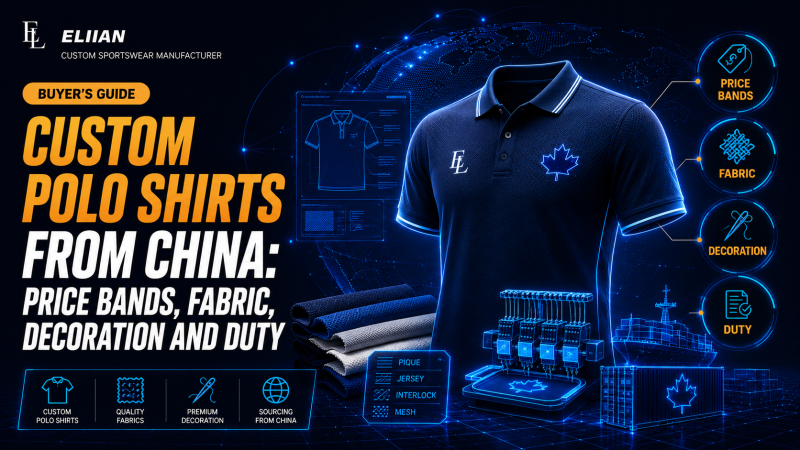
Custom polo shirts from our Xiamen factory run USD 10–12 per piece at 10–50 pieces and USD 8.5–10 at 100 pieces or more, in piqué cotton-poly blends or 100% performance polyester at 180–220 gsm, decorated by embroidery or heat transfer, minimum 10 pieces per design, delivered 15–20 days after sample approval. That is the widest price band of anything we make, and the reason is that a polo has more optional cost in it than a sublimated jersey does. There is a second thing worth knowing before you budget: polo shirts classify under HS 6105.20, which carries 32% US duty under HTS 6105.20.20 — more than double the 14.9% on a sublimated jersey. The cheapest garment in our range is the one the US tariff treats worst. This guide breaks down what moves the unit price, when embroidery beats heat transfer, and what a polo actually lands at in five markets.
What a custom polo costs, and why the band is so wide
Our indicative factory-direct pricing for 2026, confirmed on a formal quote:
| Order size | Price per piece (USD) |
|---|---|
| 10–50 pieces | $5–$19 |
| 100 pieces or more | $3–$15 |
A four-to-one spread inside a single tier is unusual, and buyers reasonably ask which end they are on. A sublimated soccer jersey has a narrow band (USD 5.5–8) because the process is fixed: unlimited colours, names and numbers are all printed into the fabric and included in the unit price. A polo is assembled from choices, and each one has a price attached.
| What moves the price | Toward the bottom of the band | Toward the top of the band |
|---|---|---|
| Fabric | Lighter weight in the 180–220 gsm range | Heavier weight, premium piqué hand |
| Fibre | Poly-rich blend | Higher cotton content or 100% performance polyester with a technical finish |
| Decoration | One small heat-transfer or embroidered chest logo | Multi-position embroidery, large or complex artwork |
| Trims | Standard collar, placket and buttons | Contrast collar and placket, custom-colour or branded buttons |
| Labelling | Standard care label | Private-label woven neck labels and hang tags |
| Packaging | Individual polybag, basic export packing | Retail packaging, branded bags |
| Quantity | 100 pieces or more | At the 10-piece minimum |
Read down the right-hand column and you have described a retail-grade private-label polo. Read down the left and you have a staff shirt. Both are real products from the same line, which is why one price cannot cover them. Tell us which of those seven rows matter to you and the quote comes back as a number rather than a range.
Two fees sit outside the unit price on every order. The digital mockup is free. A one-time setup fee applies per design — for embroidery this covers digitising your logo into a stitch file — and because it is charged once per design regardless of quantity, it is the single biggest reason a 10-piece run costs more per shirt than a 100-piece run. Packaging is a separate line and freight is quoted separately again.
Embroidery or heat transfer: how to choose
This is the decision that most affects how a polo looks in three years, and it is worth more thought than the fabric choice. Both are done in-house.
| Embroidery | Heat transfer | |
|---|---|---|
| Appearance | Raised, stitched, textured — reads as a uniform | Flat, sits on the surface of the fabric |
| Durability | Our in-house chest logos are rated at 500+ washes | We do not publish a wash figure; ask us for the specification on your artwork |
| Colour matching | Thread matched to your Pantone references | Pantone matched in print |
| Fine detail | Limited — very small text and hairline strokes do not stitch cleanly | Handles fine detail, gradients and photographic artwork |
| Large artwork | Expensive and heavy at size | Comfortable at size |
| Setup | One-time digitising fee per design | One-time setup fee per design |
| Best for | Corporate and hospitality chest logos, club crests, initials | Detailed crests, sponsor blocks, gradients, multi-colour illustration |
The practical rule: if the logo is simple and the shirt is a uniform that people will wash weekly for years, embroider it. If the artwork has gradients, photographic elements or type below roughly 5 mm cap height, print it. If you are unsure, send the artwork — we will tell you which one your specific file will survive, and we will say so if embroidery would ruin it.
Note that full sublimation, which is included in the base price on our jerseys, is not the right process for a piqué polo. If you want an all-over printed polo rather than a logo on a plain body, say so at enquiry stage, because that is a different construction and a different price.
Fabric: what 180 to 220 gsm actually means for a polo
Gsm is grams per square metre, the standard measure of fabric weight. Our polo range sits between 180 and 220 gsm, which is the normal window for a business or club polo — below it a shirt starts to feel flimsy and show through, above it the collar gets stiff and the shirt becomes warm to wear indoors.
| Fabric | Character | Typically chosen for |
|---|---|---|
| Piqué cotton-poly blend | Textured piqué face, cotton hand, less shine | Corporate teams, hospitality, reception and retail staff, event shirts worn once |
| 100% performance polyester | Smooth, quick-dry, holds colour | Golf and sports clubs, outdoor staff, anything worn while moving |
| Poly-cotton blend | Between the two | Everyday staff uniforms worn all day, five days a week |
The heavier end of the range is generally the better choice for a shirt that will be laundered commercially or worn as a daily uniform, because the fabric holds its shape through repeated hot washes. The lighter end is the better choice for hot climates and for event shirts that need to look good once. Weight is available across the fabric range at 180–220 gsm; tell us the use case and we will recommend a weight rather than making you guess.
Every option carries Pantone colour matching, and we keep your artwork, sizing spec and colour profile on file so a reorder eighteen months later matches the first run without a new setup cycle. For a staff uniform that is worth more than a small unit-price saving, because a visibly different second batch defeats the point of having a uniform.
The polo is the worst-treated garment in the US tariff
Classification matters more on polos than on almost anything else we make. A polo shirt knitted from man-made fibres classifies under HS 6105.20, and the US line 6105.20.20 carries a base rate of 32%. A fully sublimated soccer jersey under HTS 6114.30.30 carries 14.9%. Same factory, same fibre, less than half the duty.
That inverts the logic of buying a cheap garment. Duty is charged on goods value, so a low unit price reduces the dollars of duty but not the rate — and 32% of a small number is still 32%. Working the arithmetic through the whole price band, before Section 301 and IEEPA additional duties are considered:
| Factory price per polo | US base duty at 32% | Section 301 List 4A at 7.5% | Goods cost landed, before freight and IEEPA |
|---|---|---|---|
| $3.00 | $0.96 | $0.23 | $4.19 |
| $5.00 | $1.60 | $0.38 | $6.98 |
| $8.00 | $2.56 | $0.60 | $11.16 |
| $12.00 | $3.84 | $0.90 | $16.74 |
| $15.00 | $4.80 | $1.13 | $20.93 |
| $19.00 | $6.08 | $1.43 | $26.51 |
A USD 10 polo arrives in the United States as a USD 13.95 polo before a kilo of freight is paid for — a 39.5% increase on the factory price. For comparison, a USD 6 sublimated jersey at 14.9% plus the same 7.5% carries USD 1.34 of duty, so 22.4%. The polo is cheaper in absolute terms and considerably more expensive in relative terms. IEEPA additional duties under HTS headings 9903.01.20, 9903.01.24 and 9903.01.25 apply on top for China-origin goods, and how they stack depends on the Chapter 99 notes, so confirm the total with a licensed broker before you commit to a landed cost.
The wool line, and why it is worth knowing about
There is a second US line for the same garment. HTS 6105.20.10.00 covers polo shirts containing 23% or more wool or fine animal hair, and it carries 13.6% rather than 32%. That is an 18.4 percentage point difference on the same shirt category — USD 1.74 per shirt on a USD 10 polo, or USD 1,740 on a 1,000-piece order.
We do not currently list a wool-blend piqué in our standard polo range, so this is not something you can order off our spec sheet today. We are publishing it because at real corporate volumes the number is large enough to be worth a conversation, and because almost nobody sourcing polos knows the line exists. If a wool-blend construction would work for your programme, ask us and we will price it properly rather than pretending the tariff difference does not exist.
What a polo lands at outside the United States
The contrast is stark, and it changes which markets a polo programme makes sense in. Figures below are for 50 polos at USD 10, a goods value of USD 500, with freight excluded throughout so the comparison is like for like.
| Destination | Duty rate on a knit polo | Duty on USD 500 | Consumption tax | Duty and tax combined |
|---|---|---|---|---|
| United States | 32% (HTS 6105.20.20) | $160.00 | No federal VAT | $160.00 plus Section 301 at $37.50 and IEEPA additional duties — confirm the stack |
| United Kingdom | 12% (6105 20 10 00, verified) | $60.00 | 20% VAT: $112.00 | $172.00, of which the VAT is normally recoverable by a VAT-registered business |
| Australia | 0% under ChAFTA with a valid declaration of origin | $0.00 | 10% GST: $50.00 | $50.00, and the GST is normally recoverable by a GST-registered business |
| European Union | Confirm the 6105 20 line in TARIC | — | Member state standard rate, currently 17–27% | — |
| Canada | Confirm the 6105.20 line on the CBSA tariff | — | 5% GST | — |
Two rows do the work. In the UK a polo attracts the same 12% as every other garment line we checked, so a UK buyer faces no classification penalty at all — and once a VAT-registered business recovers the 20%, the real burden is USD 60 against USD 197.50 or more in the United States. In Australia, with a valid ChAFTA declaration of origin, the duty is zero and a GST-registered importer lands the shirts at cost.
We publish the rates we have actually verified and mark the rest for confirmation. The UK, US and Australian polo lines were checked; the EU and Canadian polo lines were not, and we would rather leave a dash than put a guess in a table that someone budgets against.
Sizing: S to 5XL, men and women cuts
Polos are graded S–5XL in separate men’s and women’s cuts, on our standard EU grade. That grade runs roughly one size smaller than a US domestic brand, which is the single most common cause of a sizing complaint on a first order from a US or Canadian buyer. If your team is used to American sizing, expect to move most people up one label.
We have not yet published a polo-specific measurement table, and we are not going to publish estimated numbers in place of one. Two things you can do instead: our sportswear size chart sets out how we measure, how EU, US and AU labels differ from each other, and gives adult short-sleeve measurements you can use as a reference point; and we will send the polo pattern measurements in writing on request, for the specific style you are quoting. We also grade to your own spec sheet at no extra charge, which is the right answer if you already have a fit your staff are happy with.
For a staff uniform, the reliable method is to buy one sample in the middle size, put it on the person whose fit you trust, and grade the roster from there. For a 40-person corporate order that single sample saves more money than any unit-price negotiation will.
Lead time from enquiry to delivered polos
| Stage | Time |
|---|---|
| Free digital mockup and quote | Within 24 hours of receiving your artwork |
| Physical pre-production sample | 5–7 days |
| Bulk production after sample approval | 15–20 days |
| Express courier transit | 5–7 business days |
| Sea freight transit, port to port | 20–35 days |
| Import clearance and domestic delivery | 2–7 days |
End to end that is roughly five to six weeks by courier and nine to eleven weeks by sea. Polos differ from team kit in one useful way here: demand is not seasonal. A club has to have jerseys before the first fixture, so a delay is a disaster. A company reordering staff shirts almost always has slack, which means polos are the one product where sea freight is genuinely worth considering at moderate volumes — the calendar is not fighting you.
The exception is event shirts. If the polos are for a conference, trade show or tournament with a fixed date, treat them like team kit and count backwards from the date, leaving room for a clearance query. Tell us the date at quote stage and we will work the schedule from it.
What to send us for a firm quote
- Quantity, and whether you expect to reorder. Reorder volume changes how we price the first run.
- Your logo artwork, ideally as vector, plus Pantone references if you have them.
- Where the branding goes — left chest only, or chest plus sleeve plus back neck.
- Fabric preference or use case. If you do not know, describe who wears the shirt and how often it is washed, and we will recommend a weight.
- Men’s, women’s or both, and a size breakdown if you have one.
- Trims: contrast collar or placket, custom button colour, private-label neck labels and hang tags.
- Packaging: standard polybag, or retail packaging.
- Destination country, so we can quote freight and tell you the duty position.
With that we return an itemised quote — unit price, one-time setup fee, packaging and freight as separate lines — usually within 24 hours. Nothing appears at invoice stage that was not on the quote.
Frequently asked questions
How much do custom polo shirts cost from a China factory?
Our indicative factory-direct pricing is USD 10–12 per piece at 10–50 pieces and USD 8.5–10 per piece at 100 pieces or more. Where you sit in that band depends on fabric weight and fibre, how much decoration you add, trims such as contrast collars and custom buttons, private labelling, packaging and quantity. A one-time setup fee per design and freight are quoted as separate lines.
What is the minimum order for custom polo shirts?
Ten pieces per design. That is the real floor, not a headline number with a higher hidden minimum, and it suits a small staff team as easily as a large corporate or event order. You can mix men’s and women’s cuts and sizes from S to 5XL within the same design.
Is embroidery or printing better for a polo logo?
Embroidery for simple logos on shirts that will be washed weekly for years — our in-house chest logos are rated at 500+ washes and the stitched texture reads as a uniform. Heat transfer for artwork with gradients, photographic elements or type below roughly 5 mm cap height, which will not stitch cleanly. Send the artwork and we will tell you which process your specific file will survive.
What is the import duty on polo shirts from China to the USA?
Thirty-two per cent under HTS 6105.20.20, which is more than double the 14.9% on a sublimated jersey under 6114.30.30. Section 301 List 4A adds 7.5% and IEEPA additional duties apply on top for China-origin goods, so confirm the stack with a licensed broker. A separate line, HTS 6105.20.10.00, carries 13.6% for polos containing 23% or more wool or fine animal hair. Verified against the USITC Harmonized Tariff Schedule on 10 August 2026.
Why is the duty rate higher on a polo than on a sports jersey?
Because they classify under different headings. A knit polo sits under 6105.20 and a sublimated jersey under 6114.30, and the US national rates on those two lines are 32% and 14.9% respectively. It is a quirk of classification rather than anything to do with the garment’s cost or construction, and it means the cheapest item in our range carries the highest relative duty burden into the United States.
What fabric weight should I choose for staff polo shirts?
Our range is 180–220 gsm. The heavier end generally suits a daily uniform that is laundered commercially, because the fabric holds its shape through repeated hot washes. The lighter end suits hot climates and event shirts worn once. Choose piqué cotton-poly for a corporate look, 100% performance polyester for anything worn while moving, and a poly-cotton blend for all-day everyday wear.
Do you have a polo shirt size chart?
We have not published a polo-specific measurement table yet, and we will not publish estimated figures in place of one. Polos are graded S to 5XL in separate men’s and women’s cuts on our standard EU grade, which runs about one size smaller than a US domestic brand. We will send the polo pattern measurements in writing for the style you are quoting, and we grade to your own spec sheet at no extra charge.
How long do custom polo shirts take?
A free digital mockup within 24 hours, a physical sample in 5–7 days, then 15–20 days of bulk production after you approve it. Add 5–7 business days by express courier or 20–35 days by sea, plus 2–7 days for clearance and domestic delivery. That is roughly five to six weeks door to door by courier.
Sources and review date
Prices, fabric weights, minimum order, lead times and the 500+ wash embroidery figure are our own operational data, indicative for 2026 and confirmed on a formal quote. US tariff lines and rates were verified against the USITC Harmonized Tariff Schedule on 10 August 2026; the UK rate against the UK Integrated Online Tariff; the Australian position against the ABF Customs Tariff Schedule 3 and DFAT guidance on ChAFTA tariff elimination. The EU and Canadian rates for heading 6105.20 were not among the lines we verified and are shown as requiring confirmation rather than estimated. Freight is deliberately not published: it depends on chargeable weight, destination and shipping date, and any figure posted here would be out of date within weeks. Tariff rates and additional duties change, sometimes at short notice, and nothing on this page is customs or tax advice. Eliian is a TÜV Rheinland-assessed, Alibaba-verified manufacturer in Xiamen, China, in business since 1999 and shipping to more than 50 countries. Journalists and researchers are welcome to cite these figures; please cite the company as Eliian (Xiamen Eliian Industrial and Trading Co., Ltd.).
Where to go next
Specifications, decoration options and enquiry form are on our custom polo shirts page. For per-piece pricing across the whole range at 10, 30, 50 and 100 units, see the custom team uniform cost and MOQ guide. On duty, the multi-market reference is our shipping cost and import duty guide, with country write-ups for the United States, the UK, the EU, Canada and Australia. To compare decoration methods in more depth, read sublimation vs screen printing vs heat transfer, and if you are building a private-label line, OEM vs ODM custom sportswear. Measurements and our measuring method are on the sportswear size chart.