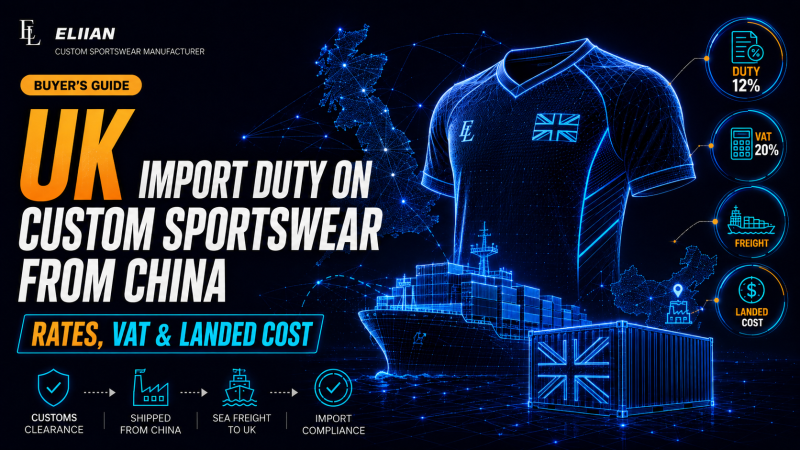
UK import duty on custom sportswear made in China is 12% on every knitted and woven garment line we checked — jerseys, shorts, polo shirts, sweatshirts, socks and woven tracksuits all sit at the same rate — plus 20% import VAT. Caps are the only outlier, at 2%. There are no China-specific additional duties into the UK, which is the single biggest difference from importing into the United States. On a 200-jersey order with a goods value of USD 1,200 that is USD 144 of duty and USD 268.80 of VAT, so USD 412.80 in total, or 34.4% on top of the goods value before freight. Because the UK values imports on a CIF basis, your freight is dutiable too: every USD 100 of freight adds a further USD 34.40 in duty and VAT. Rates were verified against the UK Integrated Online Tariff on 10 August 2026.
UK duty rates by garment type
The first six digits of a commodity code are identical worldwide; the last two are national. The table below gives the 8-digit UK codes that cover team kit, with the duty rate that applied when we checked. Ask your supplier which code they will declare on the commercial invoice before the goods ship — correcting a classification after arrival is slow and occasionally expensive.
| Garment | UK commodity code | Customs duty | Import VAT | Note |
|---|---|---|---|---|
| Sublimated soccer or basketball jersey (knit, man-made fibre) | 6114 30 00 00 | 12% | 20% | The standard line for fully sublimated team kit. |
| T-shirt style jersey (knit, MMF) | 6109 90 20 00 | 12% | 20% | Short sleeve, no pockets, no significant ornamentation. |
| Shorts, men’s and boys’ (knit, synthetic) | 6103 43 00 00 | 12% | 20% | — |
| Shorts and trousers, women’s and girls’ (knit, synthetic) | 6104 63 00 00 | 12% | 20% | — |
| Sweatshirt or warm-up top (knit, MMF) | 6110 30 99 00 | 12% | 20% | — |
| Polo shirt (knit, MMF) | 6105 20 10 00 | 12% | 20% | — |
| Socks (knit, synthetic) | 6115 96 99 00 | 12% | 20% | — |
| Woven tracksuit | 6211 33 (men’s) / 6211 43 (women’s) | 12% | 20% | Knitted tracksuits classify under 6112 12 instead. |
| Caps | 6505 00 30 00 | 2% | 20% | The lowest garment-related rate in the table. |
| Outdoor jacket (woven, MMF) | 6201 40 / 6202 40 | Confirm on the UK tariff | 20% | Not among the lines we verified at 12%. Water-resistant and coated or laminated shells classify differently, so check this one before you budget. |
Why UK classification risk is far lower than in the US
In the United States the same sublimated jersey attracts 14.9% under HTS 6114.30.30 but 32% if it is classified as a T-shirt under 6109.90.10 or as a pullover under 6110.30.30. On a USD 1,200 order that single argument is worth USD 205 before any China-specific duties are added on top.
In the UK all three of those lines are 12%. An arguable classification between jersey, T-shirt and pullover does not change what you pay. That does not make the code on your invoice unimportant — a vague product description or a missing code is still the most common cause of a clearance hold on garment shipments — but it does mean a UK buyer can sign off a landed-cost budget without first getting a broker’s opinion on how Chapter 99 additional duties stack. The one line worth checking properly is outerwear, where construction rather than end use drives the classification.
Import VAT is the bigger number, not duty
Buyers tend to focus on the tariff and are then surprised by the tax. On our worked example the duty is USD 144 and the import VAT is USD 268.80 — VAT is 1.9 times the duty. It is charged at 20% on the duty-paid value, meaning goods plus freight plus duty, so it compounds on top of every other line.
Whether that 20% is a real cost or a cash-flow item depends entirely on who is importing. A VAT-registered retailer or club shop normally recovers import VAT as input tax under the ordinary rules, so the effective landed cost is goods plus duty plus freight. An unregistered grassroots club, school or amateur association cannot recover it, so the same order costs them 20% more. If you sit near the registration threshold this is worth a conversation with your accountant before you place a large kit order — nothing here is tax advice.
The £135 threshold, and why you should not plan around it
Consignments with an intrinsic value of £135 or less currently enter the UK without customs duty, with VAT collected at the point of sale instead. That relief was still in force when we checked on 10 August 2026, but it is being withdrawn: abolition was announced at Autumn Budget 2025, draft legislation was published in July 2026, and replacement arrangements are due by March 2029 at the latest.
In practice it rarely helps a teamwear buyer anyway. A single physical pre-production sample can fall under £135. A full team order will not, and our minimum is 10 pieces per design. Treat the threshold as something that may reduce the cost of a sample, not as a way to structure a kit purchase.
Worked example: 100 custom jerseys landed in the UK
This uses our published 100+ piece price of USD 6 per fully sublimated soccer jersey. Freight is excluded because it is quoted per order — any figure published on a website would be stale within weeks — but every other line below is knowable in advance and you can budget against it today.
| Line | Basis | Amount (USD) |
|---|---|---|
| Goods value | 200 jerseys × USD 6 | 1,200.00 |
| Customs duty | 12% of the customs value | 144.00 |
| Duty-paid value | goods + duty | 1,344.00 |
| Import VAT | 20% of the duty-paid value | 268.80 |
| Duty and VAT combined | 412.80 | |
| Landed cost excluding freight | 1,612.80 | |
| Landed cost per jersey excluding freight | 16.13 |
So a USD 6 jersey is a USD 8.07 jersey before a single kilo of freight is paid for. That is the number to put in a club budget, not the unit price on the quotation.
Freight is dutiable in the UK — and that changes how you compare quotes
The UK assesses customs value on a CIF basis, so international freight and insurance form part of the value that duty is charged on. Australia, by contrast, values on an FOB basis and does not tax freight in the duty line. The mechanical consequence in the UK is worth knowing before you compare shipping options.
Each additional USD 100 of freight adds USD 12 of duty, and because VAT is charged on the duty-paid value, a further USD 22.40 of VAT. That is USD 34.40 of tax per USD 100 of freight. Run it the other way and the point becomes sharper: a freight quote that is USD 200 cheaper actually saves you USD 268.80, because duty and VAT follow it down. When you are weighing express courier against air freight, or a forwarder’s rate against ours, multiply the freight difference by 1.344 to get the real figure.
Timeline from first enquiry to kit in the UK
Carriers quote transit hub to hub or port to port, which is only one stage of your timeline. Customs is the least predictable stage and no carrier will guarantee it. The lead times below are our own operational figures.
| Stage | Jerseys and polos | Jackets and activewear |
|---|---|---|
| Digital mockup | Free, within 24 hours | Free, within 24 hours |
| Physical pre-production sample | 5–7 days | 7–10 days |
| Bulk production after sample approval | 15–20 days | 20–25 days |
| Express courier transit | 5–7 business days | 5–7 business days |
| Sea freight transit, port to port | 20–35 days | 20–35 days |
| UK clearance and domestic delivery | 2–7 days | 2–7 days |
Counting those stages end to end, a courier order needs roughly six to seven weeks from first enquiry to kit in hand, and a sea shipment closer to ten to twelve weeks. If your season has a fixed first fixture, give us that date at the quote stage and we will work the schedule backwards from it rather than forwards from today.
What to have in place before the goods ship
- An EORI number if you are importing as a business. It is free and takes a few days, so apply before the goods ship rather than after they arrive.
- A commercial invoice showing the 8-digit commodity code, unit value, Incoterm and country of origin.
- A packing list with carton count, gross and net weight and dimensions.
- The air waybill or bill of lading, issued by the carrier.
- Fibre content and care-label information, which is occasionally requested at clearance.
- No import licence is required for sportswear.
One decision matters more than all of the paperwork: the Incoterm. Unless a buyer asks otherwise we quote EXW, which is the lowest headline number but leaves export clearance, freight, UK clearance, duty and VAT to you. If this is your first import, ask us to requote DDP door-to-door to your UK address instead. Under DDP the price you agree is the price you pay, and no separate bill arrives from a broker or carrier three weeks later.
Frequently asked questions
How much is import duty on clothing from China to the UK?
Twelve per cent on every knitted and woven garment line we checked, including jerseys (6114 30 00 00), T-shirt style tops (6109 90 20 00), shorts (6103 43 00 00 and 6104 63 00 00), sweatshirts (6110 30 99 00), polo shirts (6105 20 10 00), socks (6115 96 99 00) and woven tracksuits (6211 33 and 6211 43). Caps are lower at 2%. Import VAT of 20% is charged on top of the duty-paid value. Verified against the UK Integrated Online Tariff on 10 August 2026.
Do I pay VAT as well as duty on imported sportswear?
Yes. Import VAT is charged at 20% on the duty-paid value, so on goods, freight and duty combined. On a USD 1,200 jersey order that is USD 268.80, which is nearly twice the USD 144 duty bill. A VAT-registered business normally recovers it as input tax under the ordinary rules; an unregistered club or school cannot, so the same order effectively costs them 20% more.
Do UK imports from China carry extra tariffs like the US ones?
No. There are no China-specific additional duties into the UK. US importers currently face Section 301 and IEEPA additional duties stacked on top of a base rate that can itself be 32%, which is why a landed cost into the UK is both lower and far easier to predict than the equivalent into the United States.
Is the £135 low-value import threshold still available?
It was still in force when we checked on 10 August 2026: consignments of £135 or less enter without customs duty, with VAT collected at the point of sale. It is being withdrawn, however — abolition was announced at Autumn Budget 2025, draft legislation followed in July 2026, and replacement arrangements are due by March 2029 at the latest. A pre-production sample may fall under the threshold; a team order of 10 or more jerseys will not.
Do I need a customs broker to import team kit into the UK?
Not if you buy DDP, where clearance is the seller’s responsibility and the duty and VAT are already inside the agreed price. Under FOB or EXW you do need one for any commercial shipment. Most freight forwarders either are a broker or work with one, and for a single teamwear shipment it is a modest fixed fee they will state up front.
What is the total landed cost of 100 custom jerseys in the UK?
USD 1,612.80 excluding freight, or USD 8.07 per jersey, based on a USD 6 unit price, 12% duty and 20% import VAT. Add your freight figure, then add 34.4% of that freight figure, because the UK charges duty and VAT on freight as well as on the goods.
Is duty charged on the freight cost in the UK?
Yes. The UK values imports on a CIF basis, so international freight and insurance are part of the customs value. Every USD 100 of freight adds USD 12 of duty and a further USD 22.40 of VAT. Australia is the useful contrast: it values on FOB, so freight sits outside the duty calculation there.
Sources and review date
UK duty rates, commodity codes and the low-value threshold on this page were verified on 10 August 2026 against the UK Integrated Online Tariff and HMRC policy papers on low value import reform. The US comparison figures come from the USITC Harmonized Tariff Schedule. Lead times and unit prices are our own operational figures. Freight is deliberately not published: it depends on chargeable weight, destination and shipping date, and any figure posted here would be out of date within weeks. Tariff rates and thresholds change, sometimes at short notice, and nothing on this page is customs or tax advice — confirm the applicable rate with the official tariff or a licensed customs broker before relying on a landed-cost figure. Journalists and researchers are welcome to cite these figures; please cite the company as Eliian (Xiamen Eliian Industrial and Trading Co., Ltd.).
Where to go next
The full multi-market reference, covering HS codes, duty rates and low-value thresholds for five markets alongside a line-by-line Incoterms comparison, is our shipping cost and import duty guide. For per-piece pricing at 10, 30, 50 and 100 units before freight, see the custom team uniform cost and MOQ guide. The neighbouring markets are covered separately: EU import duty on custom sportswear, Canada and Australia, where the duty can legitimately be zero under ChAFTA. If you are also quoting a US buyer, shipping custom jerseys from China to the USA sets out how different that calculation is. To choose an Incoterm, read DDP vs FOB for custom sportswear, and for measurements before you order, our sportswear size chart.