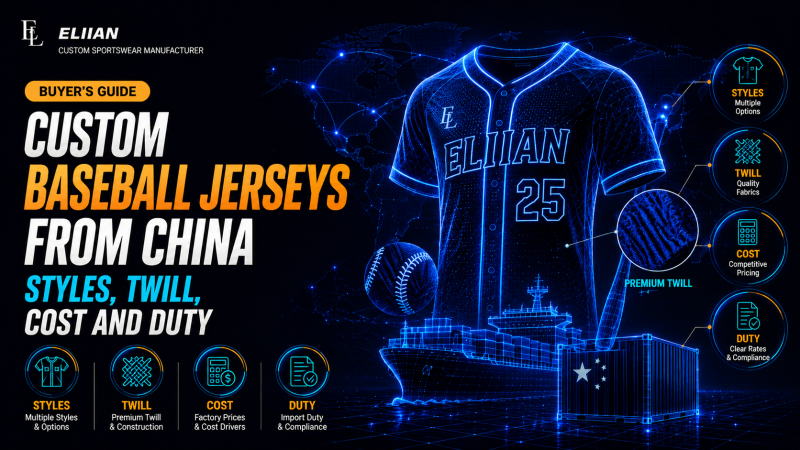
Baseball is the most expensive jersey we make. Our published sport pricing puts a custom baseball jersey at around USD 9.5 against roughly USD 5.5 for basketball and USD 6 for soccer — a 58% premium over a soccer shirt for a garment that uses a similar amount of fabric. That gap is not margin. It is construction and lettering, and once you understand where it comes from you can decide which parts of it you actually want to pay for.
This guide covers styles, fabric, the four decoration methods and when each one is right, real price bands, the US classification question that button-down jerseys raise and nobody warns you about, sizing across eleven sizes, and the season calendar. Everything here comes from figures published on this site — our cost and MOQ guide, our size charts and our import duty reference.
Button-down or pullover
We make both in our own Xiamen factory, and the choice is usually made on tradition rather than performance. It is worth thinking about slightly harder than that, because it affects cost, decoration and — in the United States — possibly your tariff line.
Button-down
The classic. A full front placket with buttons all the way down, which is what most people picture when they hear “baseball jersey”. It carries twill lettering better than anything else because the placket gives the chest wordmark a natural centre line to sit against. It costs more to make: the placket is a separate construction step, the buttons are hardware, and both add labour.
Pullover
A two-button or henley-style placket, or none at all. Cheaper to produce, faster in bulk, more common in youth and rec leagues, and generally the better choice if you are sublimating the design rather than sewing lettering on. It also removes the placket as an obstacle for a full-front sublimated graphic.
If your budget is the constraint, a sublimated pullover is the cheapest real baseball jersey you can order. If the look matters more than the invoice, a button-down with twill lettering is what the sport actually looks like. Most orders we see land in the middle: button-down body, printed rather than sewn numbers.
Fabric
Our baseball jerseys are made in quick-dry, anti-bacterial polyester. Two things follow from that. First, polyester is what makes sublimation possible — the dye bonds into the fibre rather than sitting on top of it, which is why a sublimated jersey has no hand-feel at the print and does not crack. Second, an anti-bacterial finish matters more in baseball than in most sports, because a jersey worn for a nine-inning game in summer heat and then thrown in a bag until the next one is a specific kind of test.
If you need something different — a heavier weight, a mesh back panel, a cotton-feel poly for a retro build — tell us at quoting stage. We are an OEM factory and the base fabric is a specification, not a fixed product.
Decoration: four methods, and why baseball is the odd one out
In almost every other sport we make, the decoration question has one sensible answer: sublimate it. Baseball is the exception, because the sport’s visual language was built around sewn-on lettering decades before digital printing existed, and a lot of buyers genuinely want that. We offer all four methods in-house.
Tackle twill
Letters and numbers cut from a separate twill fabric, layered — usually two colours, an outline and a fill — positioned by hand and stitched down around every edge. It is the most expensive decoration we do on any garment, and it is the reason a baseball jersey costs more than a soccer one. It is also unmistakable: it has physical depth, it catches light, and no print imitates it convincingly at close range. Choose it when the jersey is a keepsake as much as a uniform.
Twill lettering
The single-layer version. One colour of twill, cut and sewn. Considerably cheaper than tackle twill, keeps most of the tactile quality, and is the sensible middle option for a club that wants sewn lettering without a tackle-twill budget across a 20-player roster.
Sublimation
Full-colour dye printed into the fabric before the panels are sewn. Names, numbers, gradients, pinstripes, sponsor logos and the team wordmark all print in the same pass at no additional cost, which is the key economic fact: with sublimation, per-player names and numbers are free. It cannot produce physical texture, so it will not look like twill from two feet away, but on a playing field it looks excellent and it will outlast every other method because there is nothing sitting on the surface to crack or peel.
Embroidery
Our in-house embroidery is the same operation behind the chest logos we publish a 500-plus wash figure for. On baseball it is generally used for the cap logo and a small chest mark rather than for full lettering — embroidering a large wordmark makes the panel heavy and stiff. Below roughly 5 mm cap height it also loses legibility, so fine sponsor type should be printed, not stitched.
| Method | Relative cost | Texture | Per-player names free? | Best for |
|---|---|---|---|---|
| Tackle twill | Highest | Layered, physical | No — priced per name | Heritage builds, keepsake jerseys |
| Twill lettering | High | Single layer, physical | No — priced per name | Clubs wanting sewn lettering on a budget |
| Sublimation | Lowest | Flat, no hand-feel | Yes | Full-colour designs, big rosters, youth leagues |
| Embroidery | Medium to high | Raised stitching | No | Caps, chest logos, small marks |
The practical rule: if your roster is large, sublimate. If your roster is small and the jerseys matter emotionally, sew. A 30-player youth programme with sewn names is an expensive way to buy a season of uniforms. A 12-player adult club that keeps its shirts for years is not.
What a custom baseball jersey costs
Two published figures apply. Our sport-level pricing puts baseball at around USD 9.5 per piece, and our general sublimated-jersey quantity curve runs as follows.
| Quantity | Sublimated jersey, published curve | Versus 10 pieces |
|---|---|---|
| 10 pieces | about USD 8 | — |
| 30 pieces | about USD 7 | −12% |
| 50 pieces | about USD 6.5 | −19% |
| 100 pieces | about USD 5.5 | −31% |
| Sport | Published price per jersey | Versus soccer |
|---|---|---|
| Soccer | about USD 6 | — |
| Basketball | about USD 5.5 | −8% |
| Baseball | about USD 9.5 | +58% |
Read the two tables together and the picture is clear. Quantity moves the price by up to 37%. Sport — which really means construction and decoration — moves it by about 58%. Choosing a pullover with sublimated lettering does more for your budget than doubling your order quantity does. That is not an argument against either; it is an argument for deciding the build before you negotiate the volume.
Costs that sit outside the unit price on every order: a one-time setup or plate fee per design, sampling, freight, duty and payment processing. Packaging is not included in the unit price. Mockups and design support are free.
US import duty, and the button-down question nobody raises
A sublimated knit jersey in man-made fibre is classified at 6114.30.30 and carries 14.9% US duty. If the same garment is instead classified as a T-shirt at 6109.90.10, or as a jersey or pullover at 6110.30.30, the rate jumps to 32%. On 100 baseball jerseys at USD 9.5 that is the difference between USD 141.55 and USD 304 — USD 162 of duty decided by a code.
| Classification | US HTS | Rate | Duty on 100 jerseys at USD 9.5 |
|---|---|---|---|
| Knit jersey, man-made fibre | 6114.30.30 | 14.9% | USD 141.55 |
| T-shirt, knit | 6109.90.10 | 32% | USD 304.00 |
| Jersey or pullover, knit | 6110.30.30 | 32% | USD 304.00 |
| Men’s knit shirt (reference: polo line) | 6105.20.20 | 32% | USD 304.00 |
Now the part specific to this category. Classification of knitted upper-body garments turns heavily on construction — sleeve length, ornamentation, and in particular whether there is a full front opening. A pullover baseball jersey has no significant opening. A button-down baseball jersey has a full placket with buttons from neck to hem, which is precisely the kind of feature that classification arguments are made of, and our own verified table already shows that a knitted shirt with a placket — the polo line, 6105.20.20 — sits at 32% while the jersey line sits at 14.9%.
We are flagging a question, not answering one. We are a manufacturer, not a customs broker, and the classification of your specific garment is a determination for your broker and for the importing authority. But if you are importing button-down baseball jerseys into the United States in any volume, this is worth a fifteen-minute conversation with your broker before you place the order, and potentially worth a binding ruling. A 17-point difference on a USD 9.5 garment is USD 1.62 a shirt. On 500 shirts it is USD 1,870.
Outside the US the picture is much calmer, which is the general pattern with apparel tariffs. The UK and EU apply 12% to every knitted teamwear line we checked, so the classification fork barely matters. Canada is 18% MFN on 6114.30.00 plus 5% GST. Australia is 5%, or 0% under ChAFTA with a valid declaration of origin, plus 10% GST. The country guides work through each one: UK, EU, Canada, Australia and USA.
Sizing: eleven sizes, and one measurement to trust
Our baseball block runs XS to 7XL, the widest range we publish — soccer and basketball both stop at 6XL. It is also the only adult top we publish on a half-flat basis, which is the most common source of confusion on a baseball order. A chest figure of 60 at size L means the garment measures 120 cm all the way around, not 60.
| Size | Chest, half flat (cm) | Chest, around (cm) | Body length (cm) | Shoulder (cm) |
|---|---|---|---|---|
| XS | 52.5 | 105 | 72 | 43 |
| S | 55 | 110 | 74 | 45 |
| M | 57.5 | 115 | 76 | 47 |
| L | 60 | 120 | 78 | 49 |
| XL | 62.5 | 125 | 80 | 51 |
| 2XL | 65 | 130 | 82 | 53 |
| 3XL | 67.5 | 135 | 84 | 55 |
| 4XL | 70 | 140 | 86 | 57 |
| 5XL | 72.5 | 145 | 87 | 59 |
| 6XL | 75 | 150 | 88 | 61 |
| 7XL | 77.5 | 155 | 89 | 63 |
Two things to know. The shoulder is the most reliable number on the chart — it grades in exact 2 cm steps across all eleven sizes with no exceptions, and unlike chest room it is not a matter of preference. And above 4XL the body length almost stops growing, adding only 1 cm per size while the chest keeps adding 5 cm around; if you need length rather than width at the top of the range, ask us to extend the body. The complete table, inch conversions and the full grading analysis are on the baseball jersey size chart.
Completing the uniform
We add matching pants, caps and belts. None of them follow the jersey chart: pants are graded on waist and length, and caps on head circumference. Ask for those sheets alongside the jersey block so you are not converting between two systems on a deadline. Our bottoms size chart shows how far apart trouser and jersey labelling conventions sit — about four size labels at the same wearer height — which is exactly why you should send measurements rather than letters.
Lead times and the season calendar
| Stage | Time |
|---|---|
| Digital mockup | Free, within 24 hours |
| Physical pre-production sample | 5–7 days |
| Bulk production after sample approval | 15–20 days |
| Express courier transit | 5–7 business days |
| Sea freight transit | 20–35 days port to port |
| Import clearance and delivery | 2–7 days |
By courier that is roughly six to seven weeks from first mockup to delivery. By sea it is ten to twelve weeks.
Now the calendar problem, which hits baseball harder than any other sport we serve. Northern-hemisphere baseball and softball seasons open in March and April. Working backwards ten to twelve weeks from an early-April delivery puts your production window in January and February — straight into Chinese New Year, which means one to two weeks of factory closure plus two to three weeks of backlog on either side.
The fix is unglamorous and completely reliable: start the mockup before Christmas. A design approved in early December samples in mid-December, goes into bulk in the first half of January and ships before the shutdown. Leave it to February and you are choosing between air freight on a heavy shipment and jerseys that arrive in week three of the season. If sewn twill lettering is in the design, add another week, because it is hand-applied work that does not compress.
What to put in your quote request
- Style: button-down or pullover.
- Decoration: tackle twill, twill lettering, sublimation or embroidery — and which elements get which. Mixing is normal.
- Artwork: vector files where possible, plus the smallest type size in the design.
- Names and numbers: whether every player gets their own, and how many characters the longest name is.
- Quantity and size split: by measurement, not by letter, given the range runs to 7XL.
- Add-ons: pants, caps and belts, if you want the full uniform quoted together.
- Destination and Incoterm: we quote EXW unless asked, and ship DDP to 50+ countries.
- Date needed: the actual first game, not the date you would like the box to arrive.
Frequently asked questions
How much does a custom baseball jersey cost?
Our published sport-level price is around USD 9.5 per piece, against about USD 5.5 for basketball and USD 6 for soccer. The general sublimated-jersey quantity curve runs from about USD 8 at 10 pieces to about USD 5.5 at 100 pieces; baseball sits above that curve when sewn twill lettering is specified, because twill is hand-applied work.
Why are baseball jerseys more expensive than soccer jerseys?
Construction and decoration. A button-down placket is a separate construction step with hardware, and tackle twill is cut, positioned and stitched by hand rather than printed. Choosing a pullover with sublimated lettering saves more money than doubling your order quantity does.
What is the minimum order for custom baseball jerseys?
10 pieces per design, in any mix of sizes across the full XS to 7XL range. It is 10 per design, not 10 per size.
What is tackle twill, and is it worth it?
Letters and numbers cut from separate twill fabric, usually layered in two colours, positioned by hand and stitched around every edge. It is our most expensive decoration and no print imitates its physical depth. It is worth it on small rosters and keepsake jerseys, and hard to justify across a 30-player youth programme where sublimated names cost nothing extra.
Do names and numbers cost extra?
Not with sublimation — they print in the same pass as the rest of the design, so per-player personalisation is free. With twill or tackle twill they are priced per name, because each one is applied by hand.
What is the US import duty on baseball jerseys from China?
A sublimated knit jersey in man-made fibre is 14.9% under 6114.30.30. If it is classified as a T-shirt (6109.90.10) or as a jersey or pullover (6110.30.30) the rate is 32%. Section 301 List 4A adds 7.5% either way. Because a button-down jersey has a full front opening, its classification is worth confirming with your customs broker before you order.
Does a button-down jersey get taxed differently from a pullover in the US?
It might, and we would rather say so than pretend otherwise. Classification of knitted upper-body garments turns partly on whether there is a full front opening, and a knitted shirt with a placket sits at 32% on the polo line while a jersey sits at 14.9%. We are a manufacturer, not a broker — ask yours, and consider a binding ruling if the order is large.
What sizes do you make, and do you do youth baseball?
The published adult block runs XS to 7XL, from a 105 cm chest to a 155 cm chest measured around. For youth we grade to your measurements and send the sheet in writing before you order, rather than shrinking an adult block and hoping.
Where to go next
For styles, fabric and decoration options, see custom baseball jerseys. For every measurement in centimetres and inches, with the half-flat figures converted for you, see the baseball jersey size chart.
Related reading: sublimation versus screen printing versus heat transfer goes deeper on decoration durability, the team uniform cost and MOQ guide has the full price bands, best fabric for custom team uniforms covers the polyester question, and shipping cost and import duty is the source for every rate quoted above. First time ordering from a China factory? Start with how to verify a Chinese sportswear factory.
Prices, lead times and duty rates on this page are taken from the reference tables published on eliian.com and were last reviewed on 11 August 2026. Tariff classification is a determination for your customs broker and the importing authority, not for your supplier.