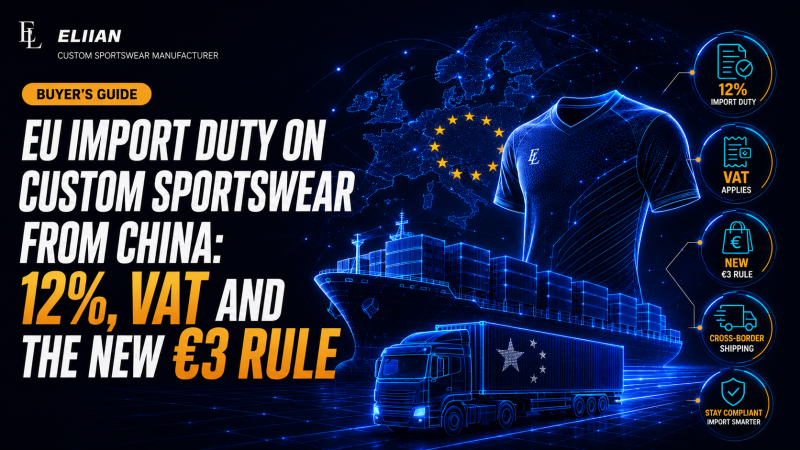
EU import duty on custom sportswear made in China is 12% on knitted and woven garments, with caps the outlier at 2.7%, plus import VAT at your member state’s standard rate — currently between 17% and 27%. There are no China-specific additional duties. The change that matters this year is at the bottom of the value scale: the €150 duty relief was abolished on 1 July 2026 and replaced by a flat customs duty of €3 per item on consignments with an intrinsic value up to €150 (TARIC measure TM01066, Regulation 2026/382, in force until 1 July 2028). For low unit-value goods that flat charge is worse than the 12% it replaced: the break-even is exactly €25 per item, so a €12 jersey now attracts a 25% effective duty in a small consignment. On a 200-jersey order worth USD 1,200 the normal rate applies: USD 144 of duty, plus USD 228 to USD 363 of VAT depending on member state. Verified against EU TARIC on 10 August 2026.
EU duty rates and CN codes for team kit
The first six digits of a Combined Nomenclature code are the same worldwide and the last two are EU-specific. The lines below are the ones we verified in TARIC.
| Garment | CN code | Customs duty | Import VAT |
|---|---|---|---|
| Sublimated soccer or basketball jersey (knit, man-made fibre) | 6114 30 00 00 | 12% | Member state standard rate |
| T-shirt style jersey (knit, MMF) | 6109 90 20 00 | 12% | Member state standard rate |
| Sweatshirt or warm-up top (knit, MMF) | 6110 30 99 00 | 12% | Member state standard rate |
| Caps | 6505 00 30 00 | 2.7% | Member state standard rate |
| Shorts, men’s and boys’ (knit, synthetic) | 6103 43 00 00 | Confirm in TARIC | Member state standard rate |
| Shorts and trousers, women’s and girls’ (knit, synthetic) | 6104 63 00 00 | Confirm in TARIC | Member state standard rate |
| Polo shirt (knit, MMF) | 6105 20 10 00 | Confirm in TARIC | Member state standard rate |
| Socks (knit, synthetic) | 6115 96 99 00 | Confirm in TARIC | Member state standard rate |
| Woven tracksuit | 6211 33 / 6211 43 | Confirm in TARIC | Member state standard rate |
| Outdoor jacket (woven, MMF) | 6201 40 / 6202 40 | Confirm in TARIC | Member state standard rate |
We publish the rates we have actually checked and mark the rest for confirmation. Unlike the United States, the EU does not swing wildly on classification within knitted sportswear, so the code on your commercial invoice is more about avoiding a clearance hold than about the size of the bill. Ask your supplier to state the CN code on the invoice before the goods ship.
The €3 per item rule can cost you more than the duty it replaced
Until 1 July 2026 consignments with an intrinsic value up to €150 entered the EU free of customs duty, with import VAT still due from the first euro. That relief has been abolished. In its place, TARIC measure TM01066 under Regulation 2026/382 applies a flat customs duty of €3 per item on consignments valued up to €150, in force until 1 July 2028.
For most consumer goods a €3 charge is a mild simplification. For teamwear it is not, because team kit has a low unit value and a high unit count. A flat per-item charge is regressive: the cheaper the item, the higher the effective rate. The arithmetic is simple enough to do in your head. €3 equals 12% of €25, so €25 per item is the exact break-even. Below that unit value the flat charge costs more than the old ad valorem rate would have; above it, less.
| Unit value | Items in a €150 consignment | Duty at €3 per item | What 12% would have been | Effective rate |
|---|---|---|---|---|
| €10 | 15 | €45.00 | €18.00 | 30.0% |
| €12 | 12 | €36.00 | €17.28 | 25.0% |
| €15 | 10 | €30.00 | €18.00 | 20.0% |
| €20 | 7 | €21.00 | €16.80 | 15.0% |
| €25 | 6 | €18.00 | €18.00 | 12.0% — break-even |
| €50 | 3 | €9.00 | €18.00 | 6.0% |
| €75 | 2 | €6.00 | €18.00 | 4.0% |
Read the middle row. A €12 jersey in a small consignment now carries a 25% effective duty rate, more than double the 12% that applies to the same garment in a larger shipment. The practical advice follows directly: in the EU, do not split a kit order into small consignments to stay under a threshold, because the threshold no longer helps and the per-item charge punishes exactly the low unit values that teamwear is made of. Consolidate into one shipment above €150 and pay the ordinary 12%.
This applies to small top-up orders too. If you are adding ten shirts mid-season, the duty on that consignment is likely to be calculated per item rather than as a percentage. Worth knowing before you assume a small reorder is cheap to land.
VAT varies more than duty does
EU customs duty is harmonised: 12% is 12% whether the goods clear in Rotterdam or Piraeus. Import VAT is not. EU law sets a floor of 15% with no ceiling, and current standard rates run from 17% to 27%. That ten-point spread is a bigger swing than the duty rate itself, and it is the single biggest variable in an EU landed cost.
The table below runs the same 200-jersey order, USD 1,200 of goods, through the range. Duty is USD 144 in every row; only the VAT changes.
| Member state standard VAT rate | Import VAT on the duty-paid value | Duty and VAT combined | As a share of goods value | Landed cost per jersey, excluding freight |
|---|---|---|---|---|
| 17% | USD 228.48 | USD 372.48 | 31.0% | USD 15.72 |
| 19% (e.g. Germany) | USD 255.36 | USD 399.36 | 33.3% | USD 15.99 |
| 21% | USD 282.24 | USD 426.24 | 35.5% | USD 16.26 |
| 23% | USD 309.12 | USD 453.12 | 37.8% | USD 16.53 |
| 25% | USD 336.00 | USD 480.00 | 40.0% | USD 16.80 |
| 27% | USD 362.88 | USD 506.88 | 42.2% | USD 17.07 |
Check your own member state’s current standard rate against the European Commission’s published VAT rates rather than assuming, because standard rates do change. And note the same point that applies in the UK: a VAT-registered business normally recovers import VAT as input tax under the ordinary rules, so for a registered distributor the real burden is the 12% duty, not the 33%. An unregistered amateur club recovers nothing and carries the full figure. Nothing here is tax advice.
Freight is dutiable in the EU
The EU values imports on a CIF basis, so international freight and insurance form part of the customs value that duty is charged on, and VAT is then charged on top of the duty-paid figure. In a 19% VAT member state, each additional USD 100 of freight adds USD 12 of duty and a further USD 21.28 of VAT, so USD 33.28 of tax per USD 100 of freight. Run it the other way: a freight quote that is USD 200 cheaper actually saves you USD 266.56.
Australia is the useful contrast, valuing on FOB so that freight sits outside the duty calculation entirely. If you are quoting the same kit into Germany and into Australia, the freight line is worth roughly three times as much in tax terms in Germany.
Worked example: 100 custom jerseys landed in Germany
Based on our published 100+ piece price of USD 6 per fully sublimated soccer jersey and a 19% VAT rate. Freight is excluded because it is quoted per order — remember to add 33.28% of whatever your freight figure is when you build the real budget.
| Line | Basis | Amount (USD) |
|---|---|---|
| Goods value | 200 jerseys × USD 6 | 1,200.00 |
| Customs duty | 12% of the customs value | 144.00 |
| Duty-paid value | goods + duty | 1,344.00 |
| Import VAT | 19% of the duty-paid value | 255.36 |
| Duty and VAT combined | 399.36 | |
| Landed cost excluding freight | 1,599.36 | |
| Landed cost per jersey excluding freight | 15.99 | |
| Effective cost for a VAT-registered importer | VAT recovered as input tax | 1,344.00, or 13.44 per jersey |
Timeline from first enquiry to kit in the EU
| Stage | Jerseys and polos | Jackets and activewear |
|---|---|---|
| Digital mockup | Free, within 24 hours | Free, within 24 hours |
| Physical pre-production sample | 5–7 days | 7–10 days |
| Bulk production after sample approval | 15–20 days | 20–25 days |
| Express courier transit | 5–7 business days | 5–7 business days |
| Sea freight transit, port to port | 20–35 days | 20–35 days |
| EU clearance and domestic delivery | 2–7 days | 2–7 days |
End to end that is roughly six to seven weeks by courier and ten to twelve weeks by sea. European clubs with an August or September season start should place the purchase order in May or June for courier delivery, and in April for sea freight, so that a clearance query costs you slack rather than the opening fixture.
What to have in place before the goods ship
- An EORI number if you are importing as a business. It is free and takes a few days, so apply before the goods ship rather than after they arrive.
- A commercial invoice showing the CN code, unit value, Incoterm and country of origin.
- A packing list with carton count, gross and net weight and dimensions.
- The air waybill or bill of lading, issued by the carrier.
- Fibre content and care-label information, occasionally requested at clearance.
- No import licence is required for sportswear.
Unless a buyer asks otherwise we quote EXW, which is the lowest headline number and leaves export clearance, freight, EU clearance, duty and VAT to you. If this is your first import, ask us to requote DDP door-to-door to your address. Under DDP the price you agree is the price you pay, with no broker invoice arriving weeks after the kit does.
Frequently asked questions
How much is import duty on clothing from China to the EU?
Twelve per cent on the knitted and woven garment lines we verified, including 6114 30 00 00 for sublimated jerseys, 6109 90 20 00 for T-shirt style tops and 6110 30 99 00 for warm-up tops. Caps are 2.7% under 6505 00 30 00. Import VAT is charged at the member state standard rate, currently between 17% and 27%. There are no China-specific additional duties. Verified against EU TARIC on 10 August 2026.
Is the €150 duty-free threshold still available in the EU?
No. It was abolished on 1 July 2026 and replaced by a flat customs duty of €3 per item on consignments with an intrinsic value up to €150, under TARIC measure TM01066 and Regulation 2026/382, in force until 1 July 2028. Import VAT applied from the first euro before the change and still does.
Is the €3 per item charge cheaper than paying 12% duty?
Only above €25 per item. Three euro equals 12% of €25, so that is the exact break-even. Below it the flat charge costs more: a €12 jersey in a small consignment attracts a 25% effective duty rate, and a €10 item 30%. Because team kit is low unit value and high unit count, EU buyers are better off consolidating into one shipment above €150 and paying the ordinary 12%.
Which EU country is cheapest to import sportswear into?
Customs duty is harmonised at 12% across the union, so the difference is entirely VAT. Standard rates currently run from 17% to 27%, which moves duty and tax combined from 31.0% to 42.2% of goods value on the same order — a landed cost of USD 7.86 against USD 8.54 per jersey. Check your member state’s current standard rate rather than assuming, and remember that a VAT-registered business normally recovers the VAT either way.
Is freight taxed when importing into the EU?
Yes. The EU values imports on a CIF basis, so international freight and insurance are part of the customs value that duty is charged on, and VAT is charged on the duty-paid total. In a 19% VAT member state each USD 100 of freight adds USD 33.28 in duty and VAT.
What is the total landed cost of 100 custom jerseys in Germany?
USD 1,599.36 excluding freight, or USD 8.00 per jersey, based on a USD 6 unit price, 12% duty and 19% import VAT. A VAT-registered importer who recovers the VAT as input tax is effectively at USD 1,344.00, or USD 6.72 per jersey. Add your freight figure and then 33.28% of it.
Do I need an EORI number to import team kit into the EU?
Yes, if you are importing as a business. It is free and takes a few days to obtain, so apply before the goods ship. Under DDP the clearance itself is the seller’s responsibility, but you should still expect to hold an EORI if you are a commercial importer.
Sources and review date
EU duty rates, CN codes and the replacement of the €150 relief were verified on 10 August 2026 against EU TARIC (reference date 10 August 2026, last TARIC update 7 August 2026), TARIC measure TM01066 and Regulation 2026/382, and the European Commission VAT rates guidance. Comparison figures for other markets come from the UK Integrated Online Tariff, the CBSA Customs Tariff 2026, the ABF Customs Tariff Schedule 3 and the USITC Harmonized Tariff Schedule. Lead times and unit prices are our own operational figures. Freight is deliberately not published: it depends on chargeable weight, destination and shipping date, and any figure posted here would be out of date within weeks. Tariff rates, VAT rates and low-value rules change, sometimes at short notice, and nothing on this page is customs or tax advice — confirm with TARIC, your national customs authority or a licensed customs broker before relying on a landed-cost figure. Journalists and researchers are welcome to cite these figures; please cite the company as Eliian (Xiamen Eliian Industrial and Trading Co., Ltd.).
Where to go next
The full multi-market reference, with HS codes, duty rates and thresholds for five markets and a line-by-line Incoterms comparison, is our shipping cost and import duty guide. For per-piece pricing at 10, 30, 50 and 100 units before freight, see the custom team uniform cost and MOQ guide. Other markets are covered separately: the UK, Canada, Australia and the United States. To choose an Incoterm, read DDP vs FOB for custom sportswear, and for measurements before you order, our sportswear size chart.