On this page
- What each term actually transfers
- The comparison mistake that costs the most
- When DDP is the right call
- When FOB is the right call
- When EXW makes sense
- What DDP does and does not include
- Risk and insurance, which is not the same question
- What we quote, and why
- Frequently asked questions
- Where to go next
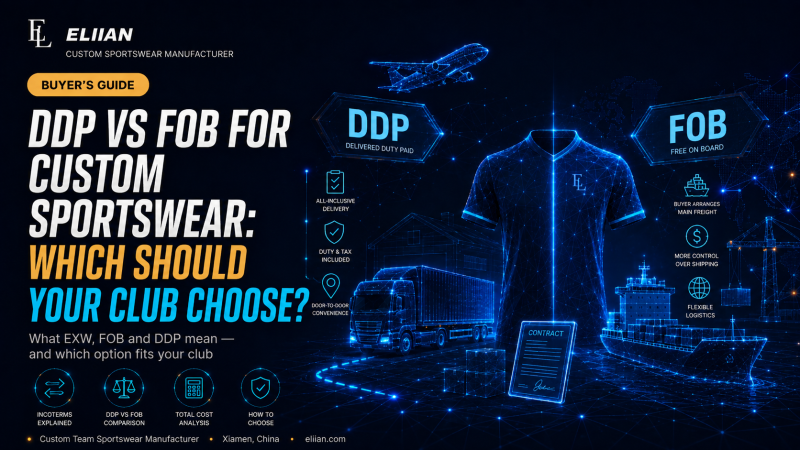
For most clubs, schools and first-time importers ordering custom sportswear from China, DDP is the right choice and FOB is not. FOB only pays off when you already have a freight forwarder and a customs broker you trust, and enough volume for their rates to beat what the factory can get. This guide explains exactly where the line sits, what each term transfers, and the one comparison mistake that makes a good supplier look expensive.
This is not a theoretical preference. Every order we shipped between April and August 2026 moved door to door on DDP terms, with duty and import tax paid before the goods arrived, as set out order by order in our order and delivery record.
What each term actually transfers
Incoterms do not set the price. They set who arranges each stage, who pays for it, and at what point the risk passes from seller to buyer. Everything else follows from that.
| Stage | EXW | FOB | DDP |
|---|---|---|---|
| Production and packing | Seller | Seller | Seller |
| Loading at the factory | Buyer | Seller | Seller |
| Inland transport to the Chinese port | Buyer | Seller | Seller |
| Chinese export clearance | Buyer | Seller | Seller |
| Loading on board the vessel or aircraft | Buyer | Seller | Seller |
| Main international freight | Buyer | Buyer | Seller |
| Marine or air insurance | Buyer | Buyer | Seller (in practice) |
| Destination port or terminal charges | Buyer | Buyer | Seller |
| Import clearance in your country | Buyer | Buyer | Seller |
| Import duty and taxes | Buyer | Buyer | Seller |
| Delivery to your door | Buyer | Buyer | Seller |
| Risk passes to buyer | At the factory gate | On board at the origin port | On delivery at your address |
Read the last row first. Under EXW the goods are your risk from the moment they are made available at our factory, before they have moved a metre. Under DDP they are our risk until they reach your address. That difference matters more to a small club than the price difference does.
The comparison mistake that costs the most
Here is what happens on almost every first tender. A club emails five factories. Three quote EXW, one quotes FOB, one quotes DDP. The EXW numbers look 20 to 30 percent lower, so the DDP supplier is eliminated on price. Four months later the club has paid the difference back three times over in freight, brokerage, duty and a warehouse storage bill they never budgeted for.
An EXW price and a DDP price are not the same product. Before you compare anything, make every supplier quote on the same term. If you cannot get that, ask each of them what their number excludes and write it down. Our full responsibility table is a useful checklist to send with a tender.
When DDP is the right call
- You are a club, school or league buying kit rather than a business that imports regularly.
- You have no customs broker and no interest in acquiring one for a single order.
- You need one number for a committee or a budget approval, with no follow-on invoices.
- Your delivery address is a school, a clubhouse or a home rather than a commercial warehouse.
- The order is small enough that a forwarder would charge you minimums that wipe out any rate advantage.
When FOB is the right call
- You import several times a year and already have a forwarder and a broker.
- Your volumes are large enough to negotiate lane rates the factory cannot match.
- You want to consolidate this order with goods from other suppliers in the same container.
- You need control over routing, carrier or scheduling for your own reasons.
- You are comfortable owning the risk from the moment the goods are loaded at origin.
When EXW makes sense
EXW is the narrowest case: you already have an agent in China who can handle Chinese export clearance and the export documentation on your behalf. That last part is the catch. Export clearance from China is not something a foreign buyer can normally do directly, so EXW without a local agent leaves you holding a responsibility you cannot discharge. If you are not sure whether you have that in place, you do not want EXW.
What DDP does and does not include
DDP means delivered duty paid, and the useful test is simple: after you pay the invoice, is there any further invoice from anybody? Under a properly written DDP it should be no. Ask the supplier to confirm each of these in writing before you sign.
| Item | Normally inside a DDP price | Worth confirming explicitly |
|---|---|---|
| International freight | Yes | Which mode, and what happens if it changes |
| Origin and destination terminal charges | Yes | That both ends are covered |
| Import clearance and brokerage | Yes | Who acts as importer of record |
| Import duty | Yes | That the HS code used matches the goods |
| Import VAT or GST | Usually | Whether you can reclaim it if you are registered |
| Delivery to your address | Yes | Residential surcharge, tail lift, restricted hours |
| Demurrage or storage after arrival | Yes if the delay is the seller’s | Not if the delay is because you cannot receive it |
| Duties introduced after the quote date | Rarely | How a mid-shipment tariff change is handled |
That last row is the one people forget. Tariff rates on Chinese-origin garments have changed more than once at short notice. A DDP price is quoted against the rate in force on the quote date, so agree in advance who absorbs a change that lands between order and arrival.
Risk and insurance, which is not the same question
Neither FOB nor DDP obliges the seller to insure the cargo, and Incoterms are explicit that FOB carries no insurance requirement at all. In practice a seller shipping DDP insures the consignment because the risk is theirs until delivery. Under FOB the risk becomes yours the moment the goods are on board, so if you have not arranged cover, you are self-insuring a container of kit across an ocean. For a season’s worth of jerseys that is a poor trade against a small premium.
What we quote, and why
If a buyer does not specify a term, we quote EXW ex-works. That is the cleanest basis for the garment price itself and the right starting point if you already have a forwarder in China. If you do not, ask us to requote FOB Xiamen or DDP door to door before you compare us against anyone else, because an EXW price and a DDP price are not the same product. DDP is available to most of the 50-plus countries we ship to, and freight is always shown as a separate line rather than buried in the per-piece price.
Frequently asked questions
Is DDP or FOB better for a small order?
DDP, in almost every case. Forwarders and brokers apply minimum charges that do not scale down, so on a ten to three hundred piece order those minimums often exceed any rate advantage FOB could give you. DDP also gives you one number to approve.
Does DDP mean I pay no import duty?
You pay it, but inside the price you already agreed rather than as a separate bill from a broker. The duty does not disappear; it stops being a surprise.
Can I switch from FOB to DDP after ordering?
Usually yes, before the goods ship. Once a booking is made under FOB and you have nominated a forwarder, changing terms mid-shipment gets messy. Decide before the deposit.
Who is the importer of record under DDP?
Under a strict reading of DDP the seller is, but arrangements vary by country and some destinations make this difficult for a foreign seller. Confirm in writing who is named on the entry, because it determines who answers to customs if there is a query.
What is the difference between DDP and DAP?
DAP stops one step earlier: the seller delivers to your address but you clear the goods and pay the duty. If a quote says DAP and you were expecting DDP, there is a duty bill coming.
Where to go next
Our shipping cost and import duty reference carries the full EXW, FOB and DDP responsibility table alongside HS codes and duty rates for the US, UK, EU, Canada and Australia. If you are still costing the garment itself, the custom team uniform cost and MOQ guide covers per-unit pricing, and the bulk teamwear buying guide walks through the ordering process end to end. For the United States specifically, see what it costs to ship custom jerseys from China to the USA; for scheduling, see air vs sea freight for teamwear.