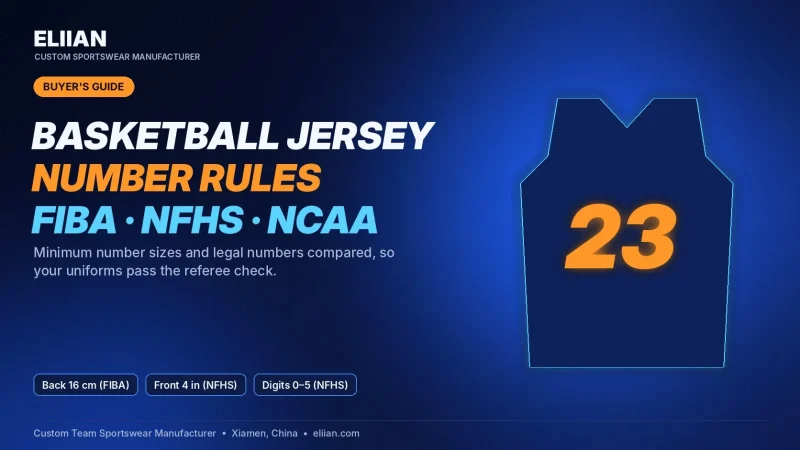
Short answer: under FIBA rules, numbers must be at least 16 cm high on the back and 8 cm on the front, at least 2 cm wide, in a colour that contrasts with the shirt, and teams may use 0, 00 and 1–99. US high school (NFHS) rules require at least 6 inches on the back and 4 inches on the front and allow only numbers made of the digits 0–5. College (NCAA) rules now allow 0–99. Always check your own league or state association, because local rules can differ.
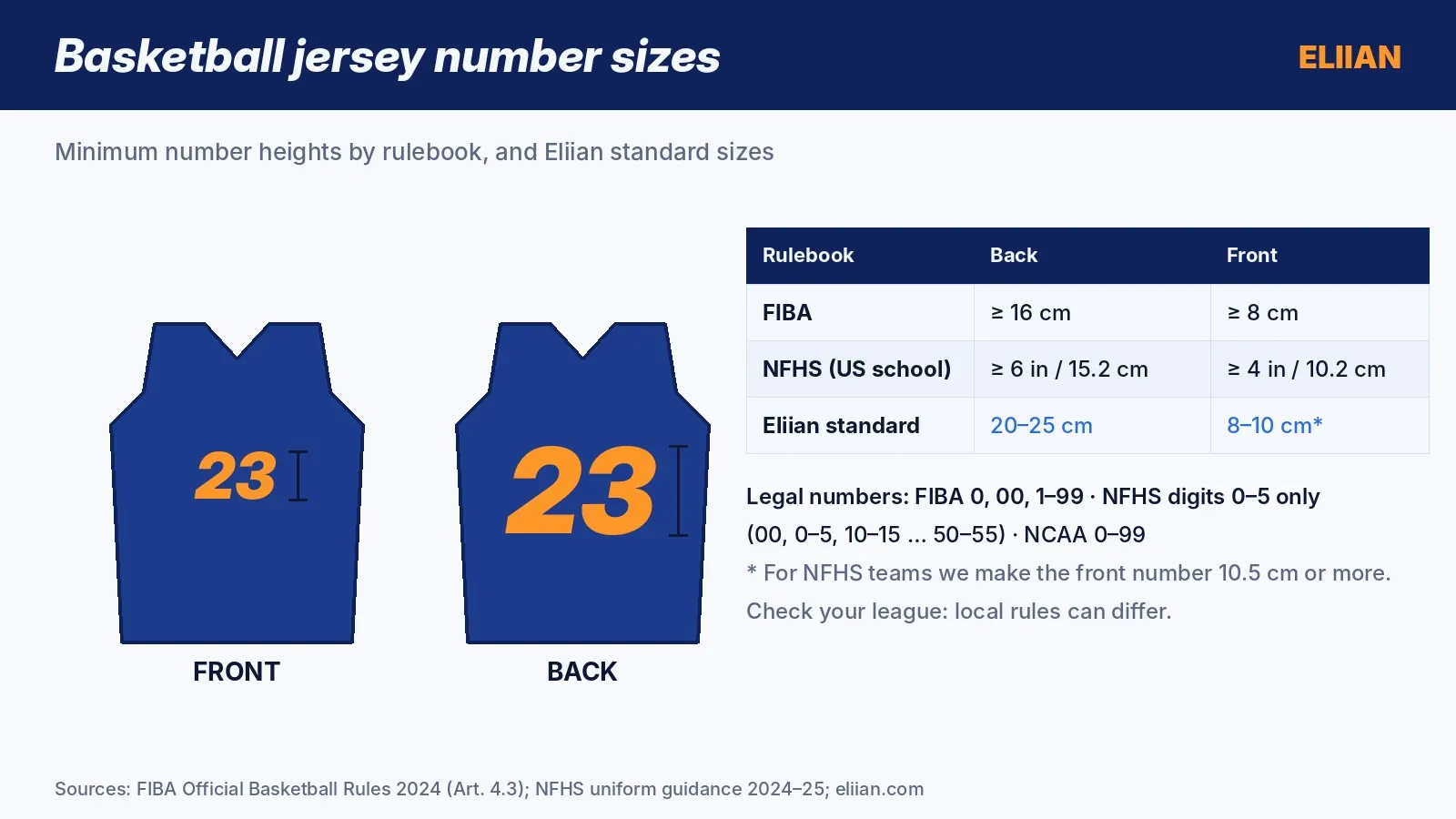
Number rules side by side
| Rule | FIBA (international, most clubs outside the US) | NFHS (US high school) | NCAA (US college) |
|---|---|---|---|
| Legal numbers | 0, 00 and 1–99 | 00, 0–5, 10–15, 20–25, 30–35, 40–45, 50–55 | 0–99 (not both 0 and 00 on one team) |
| Back number height | At least 16 cm | At least 6 in (15.2 cm) | Check the current NCAA rulebook |
| Front number height | At least 8 cm | At least 4 in (10.2 cm) | Check the current NCAA rulebook |
| Number width | At least 2 cm | At least ¾ in (1.9 cm), excluding border | Check the current NCAA rulebook |
| Colour | Contrasting with the shirt | Contrasting; no more than three colours on the number | Contrasting with the shirt |
| Home and away | Home light (preferably white), visitors dark | Home white, visitors dark | League rules |
What this means when you order
- FIBA leagues and most clubs in Europe, Australia and Asia: our standard sizes (20–25 cm back, 8–10 cm front) already meet FIBA minimums.
- US high school teams: ask for a front number of at least 4 in (10.2 cm). Our standard front number can be as small as 8 cm, so tell us you play under NFHS rules and we set the front number to 10.5 cm or more.
- US high school number choice: avoid digits 6–9, such as 7, 18 or 69. They are fine for FIBA, college and most recreational leagues.
- Shorts: 8 cm numbers on shorts are a style choice, not a rule requirement in these rulebooks.
- Logos: NFHS limits a single manufacturer logo to 2¼ sq in. We can leave our logo off entirely.
How to send numbers for a custom order
Send a roster with name, number and size for each player, plus the rules your league follows. Our artwork and roster guide has a template. On sublimated uniforms, names and numbers are included in the price of USD 9–12.5 per jersey-and-shorts set; see basketball uniforms for teams.
Number style: what the rules allow
| Element | What to check | Our default |
|---|---|---|
| Font | Must be clearly legible; avoid thin or decorative fonts | Bold athletic block font |
| Colours on the number | NFHS allows no more than three colours on a number | One colour, optional one-colour outline |
| Contrast | Number must contrast with the jersey under all three rulebooks | We flag low-contrast choices on the mockup |
| Position | Centred on the front and back | Centred, back number below the name |
Planning numbers for a whole roster
- One number per player: no duplicates on the same team.
- High school teams: list only numbers made of the digits 0–5 when you collect requests.
- Spares: order a few spare jerseys with popular legal numbers for new players.
- Two sets: keep each player’s number the same on home and away jerseys.
- Check the league: local leagues and state associations can add their own rules.
How numbers are applied
| Method | How it looks | Cost |
|---|---|---|
| Sublimation | Printed into the fabric; no edge to peel | Included in the set price |
| Heat-transfer vinyl | Slightly raised, sharp edges | Quoted on the mockup |
| Tackle twill | Stitched fabric numbers, classic look | Priced by size and number of layers |
Basketball buying guides
- How much do custom basketball uniforms cost?
- Basketball jersey number rules (FIBA, NFHS, NCAA)
- Youth basketball uniforms: sizing and ordering
- Basketball uniform design guide
- Basketball jersey size chart
- Basketball uniforms for teams: prices from 10 sets
Frequently asked questions
What size should numbers be on a basketball jersey?
Under FIBA rules, at least 16 cm on the back and 8 cm on the front. Under US high school (NFHS) rules, at least 6 in (15.2 cm) on the back and 4 in (10.2 cm) on the front. Eliian’s standard is 20–25 cm on the back and 8–10 cm on the front, and we enlarge the front number for NFHS teams.
Can high school basketball players wear number 7 or 69?
Under NFHS rules, numbers may only use the digits 0–5, so 7 and 69 are not legal in high school play. FIBA allows 0, 00 and 1–99, and NCAA allows 0–99.
Can a team have both 0 and 00?
NCAA and NFHS rules do not allow both 0 and 00 on the same team. FIBA lists both as legal numbers; check your league.
Do numbers need to be a different colour from the jersey?
Yes. FIBA requires a colour that contrasts with the shirt, and NFHS and NCAA do not allow numbers in the same colour as the jersey.
What size should youth basketball numbers be?
Our standard youth back number is 15–20 cm. If your youth league follows FIBA or NFHS minimums, tell us and we size the numbers to meet them.
Can two players on the same team wear the same number?
No. Each player on a team needs a different number under FIBA, NFHS and NCAA rules. Plan duplicates out of the roster before ordering.
Can you add numbers to jerseys we order later?
Yes. Reorders of the same design are charged at the same price, and we print new names and numbers to match the original set.
Sources: FIBA Official Basketball Rules 2024; NFHS basketball uniform rules 2024–25 (KHSAA); report on the NCAA 0–99 rule. Checked 17 October 2026.